Upper Body
Back Exercises 99 Moves With How-To Steps
99 back exercises, from the pull-up to the lat pulldown, with how to do each one. Filter by the equipment you have, then open any exercise for its steps.
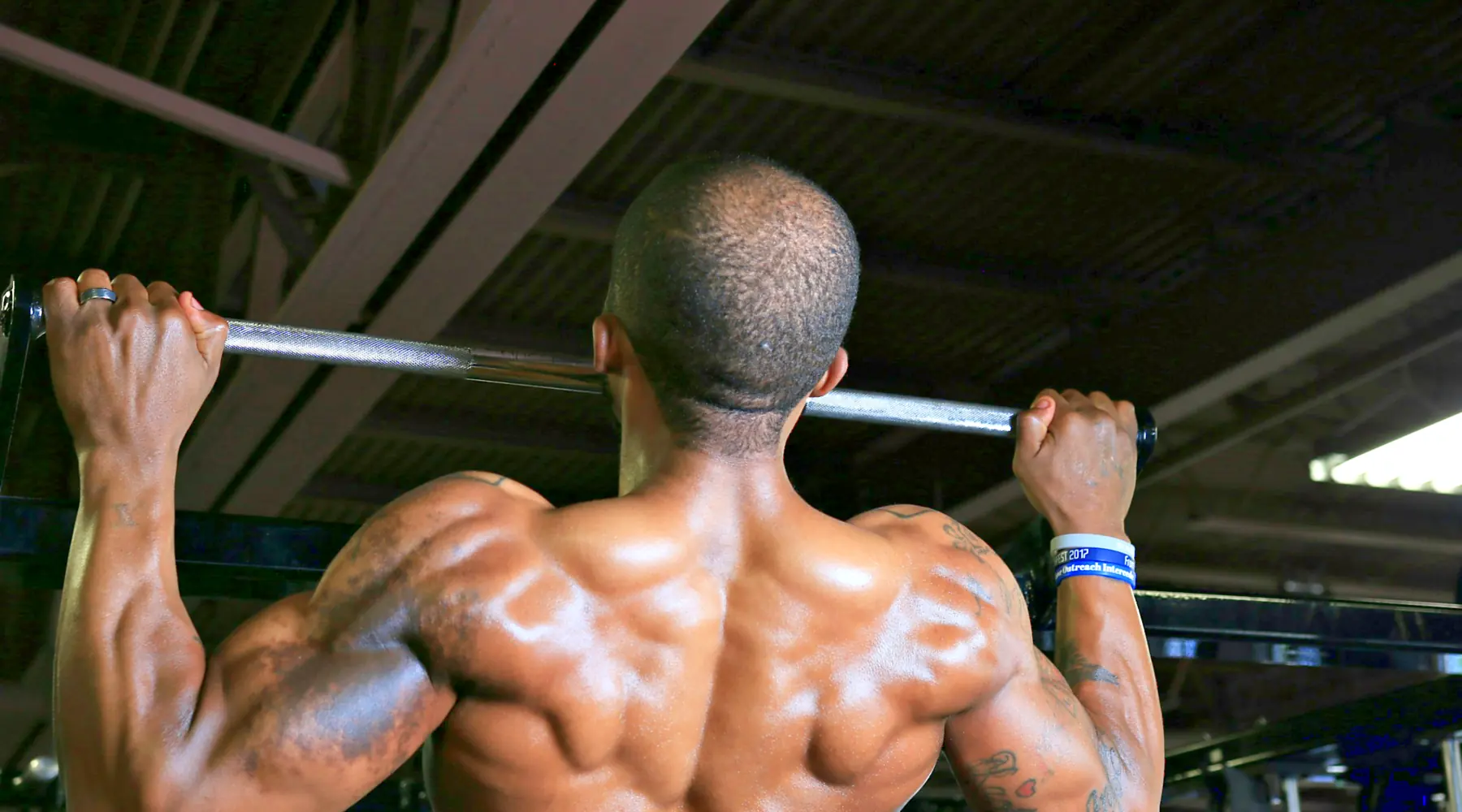
Photo: Richard R on Unsplash
Lats 50
-
Bodyweight
Steps and tips
Also works biceps and upper back.
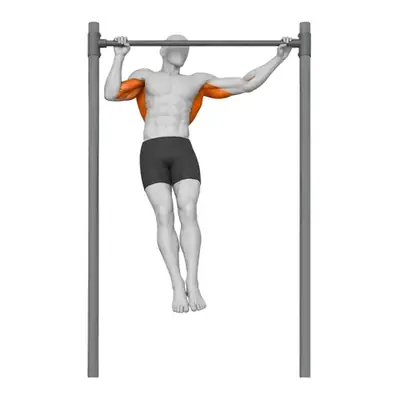
A pull-up where you pull toward one hand while the other arm straightens out along the bar. A step toward the one-arm pull-up.
How to do it
- Grab the bar with a wide overhand grip and hang with straight arms.
- Pull yourself up and toward one hand, letting the other arm straighten out along the bar.
- Get your chin over the bar beside the bent arm, then lower under control back to the hang.
- Alternate sides each rep, or finish a set on one side and then switch.
Keep in mind
- The straight arm guides and helps a little. The bent arm should be doing most of the work.
- Master strict wide pull-ups first. This is a strength skill, not a beginner move.
-
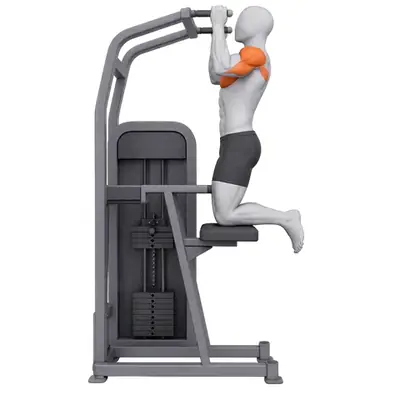
Machine
Steps and tips
Also works biceps.
A pull-up on the assisted pull-up machine, where the platform takes part of your body weight. The straightest road to a full pull-up.
How to do it
- Set the assist weight, kneel on the platform, and grab the handles with an overhand grip a little wider than your shoulders.
- Start from a full hang with your arms straight.
- Pull your chest toward the handles, driving your elbows down and back.
- Lower slowly all the way back to straight arms.
Keep in mind
- More weight on the stack means more help. Take a little off each week.
- Full range every rep. A half pull-up with less assist is not progress.
-
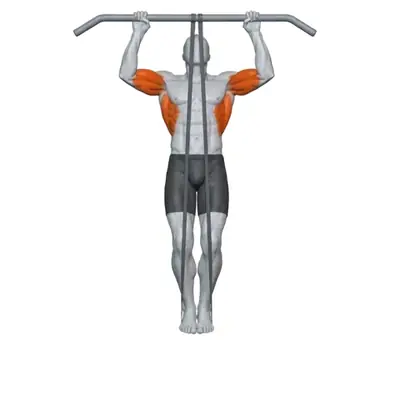
Band
Steps and tips
Also works biceps.
A pull-up with a band looped over the bar and under your feet or knees. The band helps most at the bottom, where a pull-up is hardest.
How to do it
- Loop a band over the bar, pull it down, and put one foot or knee in the loop.
- Grab the bar with an overhand grip a little wider than your shoulders and hang with straight arms.
- Pull your chin over the bar, driving your elbows down and back.
- Lower slowly all the way back to straight arms.
Keep in mind
- A thicker band gives more help. Move to a thinner one as you get stronger.
- Hold the bar before stepping into the band, and step out while still holding it.
-
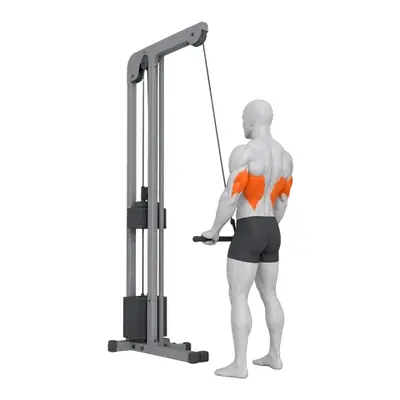
Band
Steps and tips
Pulling a band down from overhead with straight arms. Works the lats on their own, with the arms kept out of it.
How to do it
- Anchor the band high and hold it with both hands, arms straight in front of you above shoulder height.
- Step back until the band is taut, and hinge slightly forward.
- Pull your straight arms down in an arc until your hands reach your thighs.
- Return slowly to the start.
Keep in mind
- Arms stay straight with a soft elbow. Bending them turns it into a pushdown.
- Think of driving your elbows down toward your back pockets.
- The demo shows the cable version. With a band the movement is the same.
-
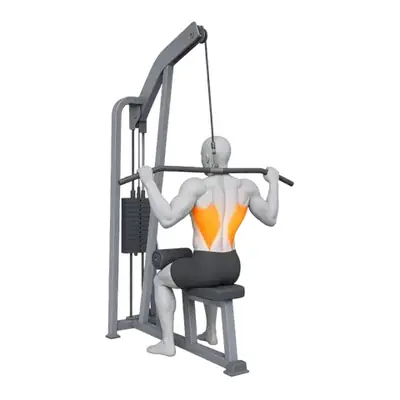
Cable
Steps and tips
Also works biceps and upper back.
A lat pulldown brought down behind the head instead of to the chest. Works the lats and upper back, but needs mobile shoulders.
How to do it
- Sit at the pulldown machine with your thighs under the pads and grip the bar wider than your shoulders.
- Lean your head slightly forward so the bar has a clear path.
- Pull the bar down behind your head until it reaches the base of your neck.
- Let it rise slowly until your arms are straight.
Keep in mind
- Only go as low as your shoulders allow without pain. Stop at ear level if you need to.
- If it bothers your shoulders at all, the front pulldown does the same job with less risk.
-
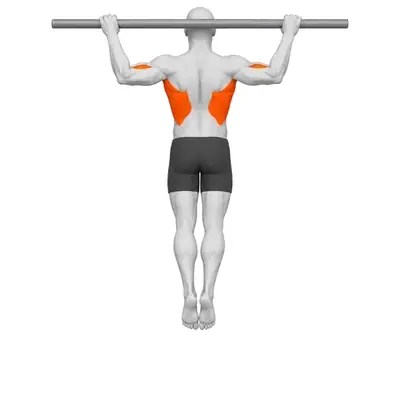
Bodyweight
Steps and tips
Also works biceps and upper back.
A wide pull-up where the bar goes behind your head instead of in front. Works the lats and upper back, but demands good shoulder mobility.
How to do it
- Grab the bar with a wide overhand grip and hang with straight arms.
- Tilt your head slightly forward and pull up so the bar passes behind your head.
- Stop when the back of your neck reaches the bar.
- Lower slowly all the way back to straight arms.
Keep in mind
- Skip this if your shoulders complain. A regular wide pull-up works the same muscles.
- Keep it strict and slow. Momentum here is hard on the shoulder joint.
-
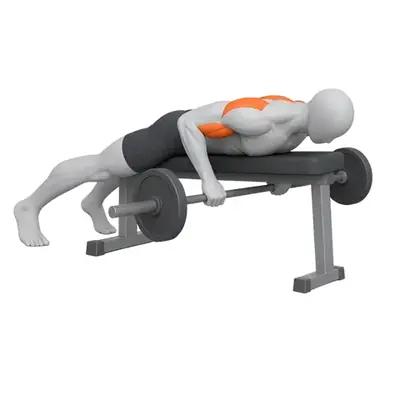
Barbell
Steps and tips
Also works upper back, biceps, rear delts and traps.
A barbell row lying face down on a high bench. The bench takes the lower back out of it, so the lats and upper back get all the work.
How to do it
- Lie face down on a high flat bench with the bar on the floor beneath you and your arms hanging straight down.
- Grip the bar a little wider than your shoulders.
- Row the bar up until it touches the underside of the bench.
- Lower it slowly until your arms are straight.
Keep in mind
- Keep your chest on the bench. Lifting it to reach the bar is cheating the range.
- Drive the elbows up and back, not out to the sides.
-
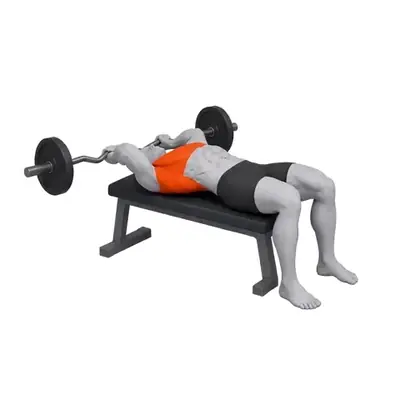
Barbell
Steps and tips
Also works chest and triceps.
A pullover with an EZ bar and the elbows kept bent. Works the lats and chest through a deep stretch overhead.
How to do it
- Lie across or along a flat bench holding an EZ bar over your chest with your elbows bent to about 90 degrees.
- Keeping the elbow bend, lower the bar back over your head until you feel a stretch in your lats.
- Pull the bar back over your chest along the same arc.
Keep in mind
- Keep the elbow bend fixed. Straightening at the bottom moves the strain to the elbows.
- Keep your ribs down. Do not arch your back to get more stretch.
-
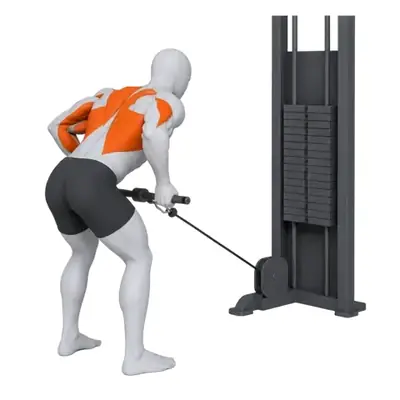
Cable
Steps and tips
Also works upper back, biceps and rear delts.
A bent-over row on a low cable. Works the lats and upper back with tension from start to finish.
How to do it
- Set the pulley low, hold the handle or bar, and step back until the weight is off the stack.
- Hinge forward with your back flat until your torso is about 45 degrees, arms straight toward the pulley.
- Row the handle to your lower ribs, driving your elbows back.
- Let it return slowly until your arms are straight.
Keep in mind
- Hold the hinge. If your torso rises as you pull, the weight is too heavy.
- Squeeze the shoulder blades together at the end of every rep.
-
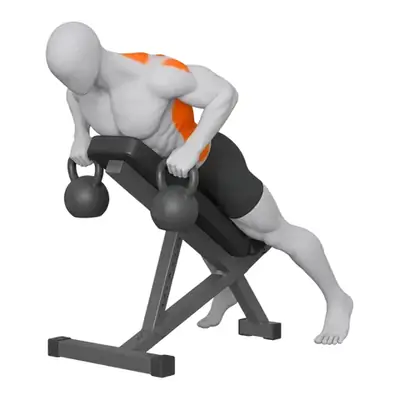
Kettlebell
Steps and tips
Also works upper back, biceps, rear delts and traps.
A row with two kettlebells lying face down on an incline bench. The bench takes the lower back out of it.
How to do it
- Set a bench to about 45 degrees and lie face down on it with a kettlebell in each hand hanging straight down.
- Keep your chest on the pad and your neck neutral.
- Row the bells up to your ribs, driving your elbows back and squeezing your shoulder blades together.
- Lower slowly until your arms are straight.
Keep in mind
- Keep your chest glued to the pad. Lifting off it is the lower back trying to help.
- A full stretch at the bottom of every rep.
-
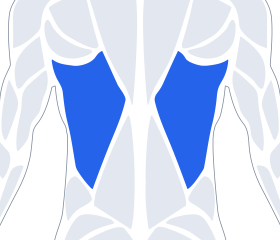
Bodyweight
Steps and tips
Also works biceps, upper back and rear delts.
A pull-up taken all the way until your chest touches the bar. A bigger range than a normal pull-up, and the standard in many gyms.
How to do it
- Grab the bar with an overhand grip a little wider than your shoulders and hang with straight arms.
- Pull your elbows down and back hard, leaning back slightly as you rise.
- Keep pulling until the bar touches your upper chest.
- Lower slowly all the way back to straight arms.
Keep in mind
- Lean back a little at the top. A perfectly vertical body cannot get the chest to the bar.
- Strict first. Kipping is a separate skill and a separate exercise.
-
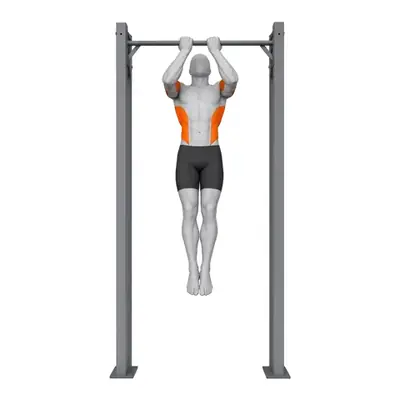
Bodyweight
Steps and tips
Also works biceps.
A pull-up with your palms facing you. Works the lats with more help from the biceps, which makes it a little easier than a pull-up.
How to do it
- Grab the bar with your palms facing you, hands about shoulder width apart, and hang with straight arms.
- Brace your core and squeeze your glutes so your body stays still.
- Pull your elbows down and back until your chin clears the bar.
- Lower slowly all the way back to straight arms.
Keep in mind
- Full hang at the bottom, chin over the bar at the top. Every rep.
- No swinging or kicking.
-
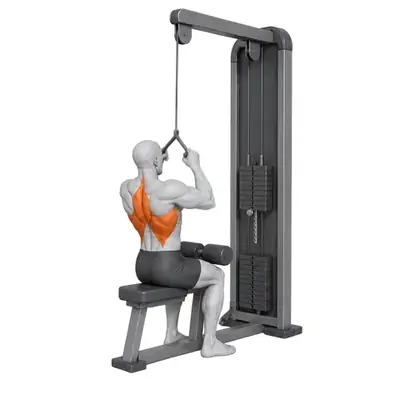
Cable
Steps and tips
Also works biceps, rear delts and upper back.
A lat pulldown with the hands close together, usually on a V handle. Works the lats through a longer range, with the biceps helping.
How to do it
- Attach a V handle or take a close grip on the bar, and sit with your thighs under the pads.
- Start with your arms straight and your chest up.
- Pull the handle down to your upper chest, driving your elbows down and back.
- Let it rise slowly until your arms are straight.
Keep in mind
- Lean back only slightly. Rocking back and forth is momentum, not lats.
- Squeeze at the bottom, then a slow full stretch at the top.
-
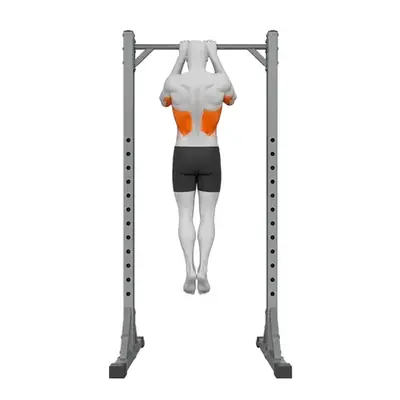
Bodyweight
Steps and tips
Also works biceps.
A pull-up with the hands set close together. Works the lats with the biceps doing a bit more.
How to do it
- Grab the bar with an overhand grip and your hands close together, and hang with straight arms.
- Brace your core and keep your body still.
- Pull your elbows down and back until your chin clears the bar.
- Lower slowly all the way back to straight arms.
Keep in mind
- Keep your elbows pointing forward and down, not out to the sides.
- Full range every rep.
-
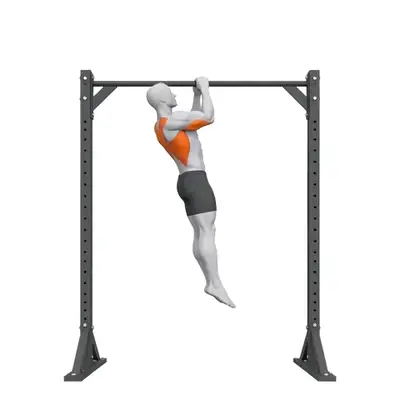
Bodyweight
Steps and tips
Also works biceps, upper back and obliques.
A pull-up with the hands one in front of the other on the bar, pulling your head up to one side and then the other. Works the lats and biceps, with the core fighting the twist.
How to do it
- Grip the bar with your hands close together, one in front of the other, so your body faces along the bar.
- Hang with straight arms and brace your core.
- Pull up until your shoulder reaches the bar, passing your head to one side of it.
- Lower under control, then pull up again with your head passing the other side. Keep alternating for the set.
Keep in mind
- Swap which hand is in front halfway through the set, or from set to set.
- Log the total reps. Each pull-up counts as one.
-
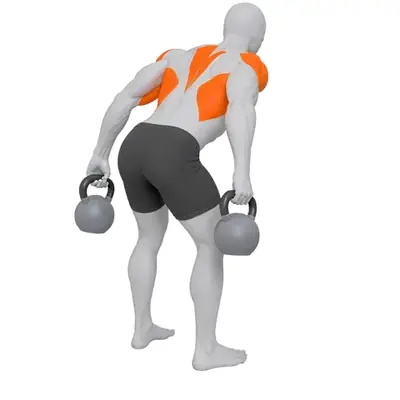
Kettlebell
Steps and tips
Also works upper back, biceps, lower back and traps.
A bent-over row with a kettlebell in each hand. Works the lats and upper back, with the lower back holding the position.
How to do it
- Stand with a kettlebell in each hand and hinge forward with a flat back until your torso is about 45 degrees.
- Let the bells hang straight down with your arms straight.
- Row both bells to your ribs, driving your elbows back.
- Lower slowly until your arms are straight.
Keep in mind
- Hold the hinge. A rising torso means the weight is too heavy.
- Keep your neck in line with your back, eyes on the floor a few feet ahead.
-
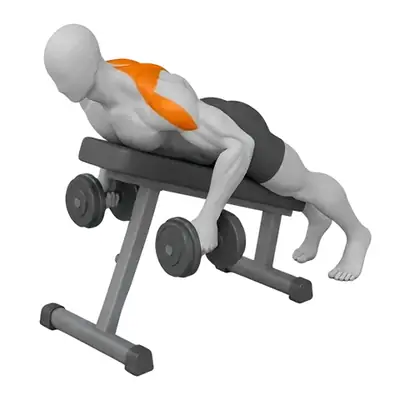
Dumbbell
Steps and tips
Also works upper back, biceps and rear delts.
A row with two dumbbells lying face down on a high bench. The bench keeps your body still, so the lats and upper back do all the work.
How to do it
- Lie face down on a high flat bench with a dumbbell in each hand hanging straight down.
- Row both dumbbells up to the sides of the bench, driving your elbows up and back.
- Squeeze your shoulder blades together at the top.
- Lower slowly until your arms are straight.
Keep in mind
- Keep your chest on the bench for the whole set.
- A full stretch at the bottom of every rep.
-
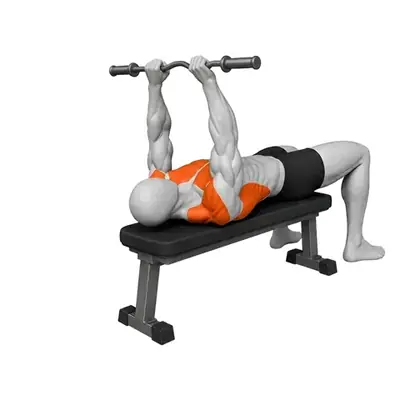
Barbell
Steps and tips
Also works chest and triceps.
Lowering an EZ bar behind your head while lying on a bench, then pulling it back over. Works the lats and chest through a deep stretch.
How to do it
- Lie on a flat bench holding an EZ bar over your chest with your arms nearly straight.
- Lower the bar in an arc back over your head until you feel a stretch in your lats and chest.
- Pull it back over your chest along the same arc.
Keep in mind
- Keep a slight bend in your elbows and hold it. Do not let them flare.
- Keep your ribs down. Arching your lower back to get more stretch is the common fault.
-
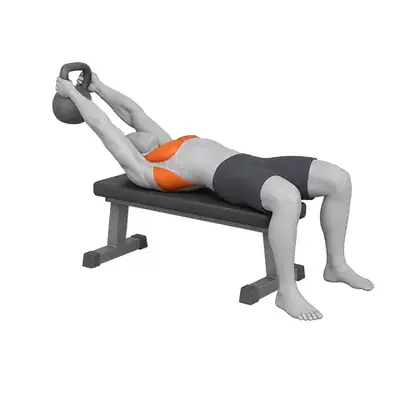
Kettlebell
Steps and tips
Also works chest and triceps.
A pullover holding one kettlebell by the horns. Works the lats and chest through a deep stretch overhead.
How to do it
- Lie on a flat bench holding a kettlebell by the horns over your chest, with your arms nearly straight.
- Lower the bell in an arc back over your head until you feel a stretch in your lats.
- Pull it back over your chest along the same arc.
Keep in mind
- Keep a slight bend in your elbows and hold it.
- Keep your ribs down and your lower back on the bench.
-
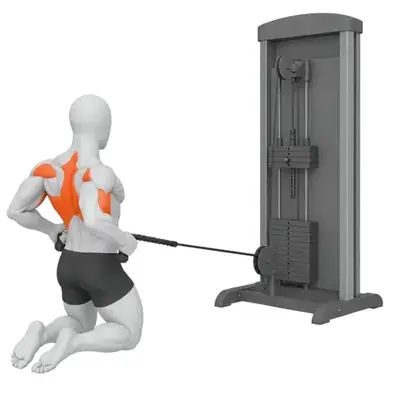
Cable
Steps and tips
Also works biceps, rear delts, upper back and traps.
A row on a cable done from a kneeling position. Kneeling takes the legs out of it and keeps the pull honest.
How to do it
- Set the pulley low or at chest height, hold the handle, and kneel facing the machine far enough back to lift the weight.
- Sit tall on your knees with your arms straight toward the pulley.
- Row the handle to your lower ribs, driving your elbows back and squeezing your shoulder blades.
- Let it return slowly until your arms are straight.
Keep in mind
- Stay tall. Leaning back to move the weight is momentum.
- Keep your shoulders down away from your ears.
-
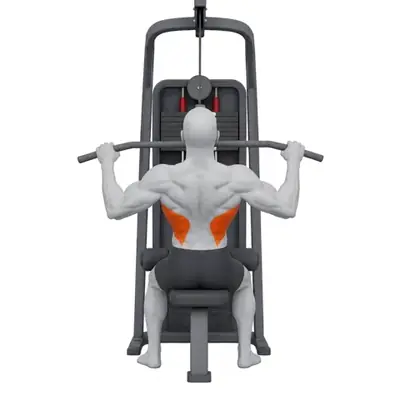
Cable
Steps and tips
Also works biceps.
A cable pull from overhead while seated. Works the lats and upper back, with the biceps helping.
How to do it
- Set the thigh pad so your legs are held snugly, then grip the bar a little wider than shoulder width.
- Sit down with your arms straight and your chest up, leaning back just slightly.
- Pull your elbows down and back until the bar reaches your upper chest.
- Pause and squeeze your shoulder blades together.
- Let the bar rise slowly under control until your arms are straight again.
Keep in mind
- Pull with your elbows, not your hands. Think of your hands as hooks.
- Do not lean way back or swing to move the weight. If you have to, it is too heavy.
- Stop the bar at your upper chest. Pulling it lower rolls the shoulders forward.
-
Dumbbell
Steps and tips
Also works upper back and biceps.
A one-arm dumbbell row that starts low and turns your torso as you pull, like starting a lawnmower. Works the lats with a twist for the core.
How to do it
- Stand in a split stance and hinge forward, holding a dumbbell in the hand opposite your front foot, reaching it toward your front foot.
- Row the dumbbell up and back toward your hip, turning your torso slightly as you pull.
- Squeeze at the top, then lower and reach back toward the front foot.
- Finish the set, then switch sides.
Keep in mind
- The turn is small. Big rotation is momentum, not lats.
- Log reps for one side. SetLift counts the other side for you.
-
Cable
Steps and tips
Also works upper back and biceps.
Pulling a rope hand over hand from a low anchor on a rope machine or functional trainer. Works the lats, upper back and grip with a pull that never stops.
How to do it
- Face the machine with the rope running from its lowest point, and take a staggered stance.
- Hinge slightly and grip the rope with one hand in front of the other.
- Pull hand over hand, driving each elbow back past your hip.
- Keep pulling for the set number of pulls or the set time.
Keep in mind
- Pull with your back, not your arms. Each hand should finish beside your hip.
- Keep your back flat and your core braced.
-
Cable
Steps and tips
Also works upper back and biceps.
Pulling a rope hand over hand from an anchor at chest height. Works the lats and upper back with a pull that never stops.
How to do it
- Face the machine with the rope running from about chest height, and take a staggered stance.
- Stand tall and grip the rope with one hand in front of the other.
- Pull hand over hand, driving each elbow back past your ribs.
- Keep pulling for the set number of pulls or the set time.
Keep in mind
- Lean back slightly and brace so the rope does not pull you forward.
- Squeeze your shoulder blade back as each hand finishes.
-
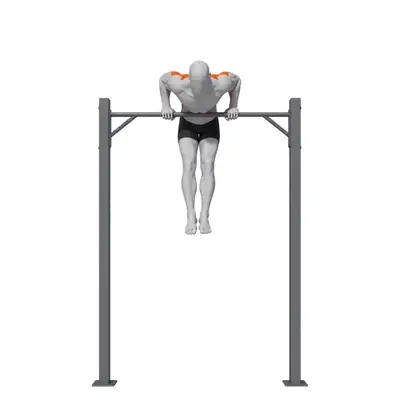
Bodyweight
Steps and tips
Also works biceps and triceps.
A pull-up that continues into a dip, taking you from hanging under the bar to pressed out above it. An advanced bar skill.
How to do it
- Hang from the bar with a false grip or a strong overhand grip and swing slightly to build a small arc.
- Pull explosively, driving the bar down toward your hips as your chest rises above it.
- Lean forward over the bar and turn your wrists over as you transition.
- Press out to straight arms, then lower back through the transition to the hang.
Keep in mind
- Build a strict chest-to-bar pull-up and a full dip first.
- The transition is the skill. Practise it on a low bar with your feet on the floor.
-
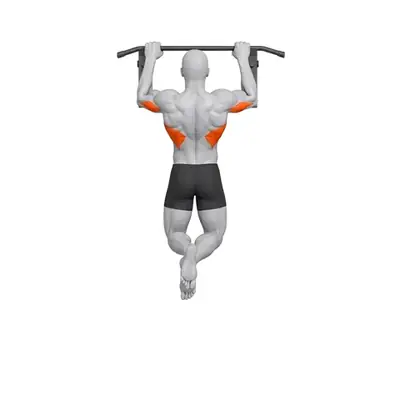
Bodyweight
Steps and tips
Also works biceps.
Only the lowering half of a pull-up, starting from the top. The best way to build the strength for a first pull-up.
How to do it
- Use a box or a jump to get your chin over the bar with your hands a little wider than your shoulders.
- Hold at the top for a second with your elbows down and back.
- Lower yourself as slowly as you can, taking three to five seconds to reach straight arms.
- Step back up and repeat.
Keep in mind
- Slow is the whole exercise. If you drop the last part, it does not count.
- Keep your shoulders down away from your ears at the bottom.
-
Machine
Steps and tips
Also works biceps.
An assisted pull-up with your palms facing each other. The neutral grip is the easiest on the shoulders and elbows.
How to do it
- Set the assist weight, kneel on the platform, and grip the neutral handles.
- Start from a full hang with your arms straight.
- Pull your chest toward the handles, driving your elbows down and back.
- Lower slowly all the way back to straight arms.
Keep in mind
- Take a little assist off each week.
- Full range every rep. Chest to the handles, arms straight at the bottom.
-
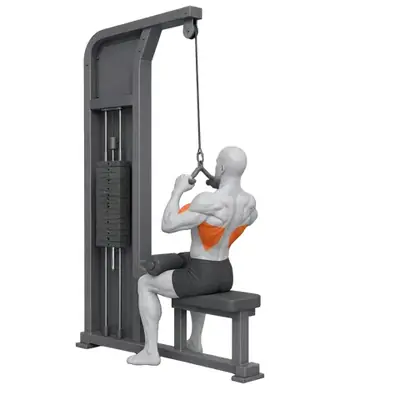
Cable
Steps and tips
Also works biceps.
A lat pulldown on a handle with the palms facing each other. Easy on the shoulders and strong on the lats.
How to do it
- Attach a neutral grip handle and sit with your thighs under the pads.
- Start with your arms straight and your chest up.
- Pull the handle down to your upper chest, driving your elbows down and back.
- Let it rise slowly until your arms are straight.
Keep in mind
- Lean back only slightly and keep it there.
- A slow, full stretch at the top of every rep.
-
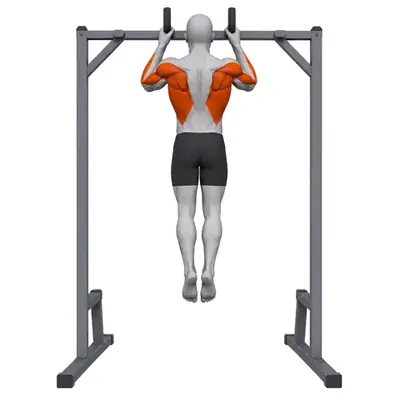
Bodyweight
Steps and tips
Also works biceps.
A pull-up on parallel handles with your palms facing each other. The most shoulder-friendly pull-up there is.
How to do it
- Grab the parallel handles and hang with straight arms.
- Brace your core and keep your body still.
- Pull your elbows down and back until your chin clears the handles.
- Lower slowly all the way back to straight arms.
Keep in mind
- Full range every rep.
- Keep your shoulders down away from your ears at the bottom.
-
MachinePlate-Loaded
Steps and tips
Also works traps and biceps.
A row on a plate-loaded machine with the handles high and in front of you, pulling down and back. Works the lats and upper back.
How to do it
- Set the seat so the handles are above and in front of you when you are seated, and set your chest against the pad if there is one.
- Grip the handles with your arms straight.
- Pull the handles down and back toward your ribs, driving your elbows back.
- Let them return slowly until your arms are straight.
Keep in mind
- Keep your chest against the pad. Pulling yourself off it is momentum.
- Load both sides evenly.
-
MachinePlate-Loaded
Steps and tips
Also works biceps.
A pulldown on a plate-loaded machine with independent arms, pulling the handles down in front of you. Works the lats one side at a time.
How to do it
- Set the seat so your thighs are held under the pads and the handles are within reach overhead.
- Grip the handles with your arms straight and your chest up.
- Pull both handles down to your upper chest, driving your elbows down and back.
- Let them rise slowly until your arms are straight.
Keep in mind
- Independent arms let a strong side hide a weak one. Watch that both handles move together.
- Squeeze at the bottom, stretch at the top.
-
MachinePlate-Loaded
Steps and tips
Also works upper back and biceps.
A wide-grip pulldown on a plate-loaded machine with independent arms. Works the lats and upper back with the elbows out wide.
How to do it
- Set the seat so your thighs are held under the pads and the wide handles are within reach overhead.
- Grip the handles with your arms straight and your chest up.
- Pull both handles down to your upper chest, driving your elbows down and out to the sides.
- Let them rise slowly until your arms are straight.
Keep in mind
- Keep your chest up and your shoulders down.
- Load both sides evenly so one arm cannot do more than the other.
-
MachinePlate-Loaded
Steps and tips
Also works upper back and biceps.
A row on a plate-loaded machine with the handles low and in front of you. Works the lats and upper back with the chest supported.
How to do it
- Set the seat so the handles are at about lower chest height and your chest sits against the pad.
- Grip the handles with your arms straight.
- Row the handles back to your ribs, driving your elbows back and squeezing your shoulder blades.
- Let them return slowly until your arms are straight.
Keep in mind
- Keep your chest on the pad the whole set.
- Squeeze at the end of every rep rather than bouncing off the stretch.
-
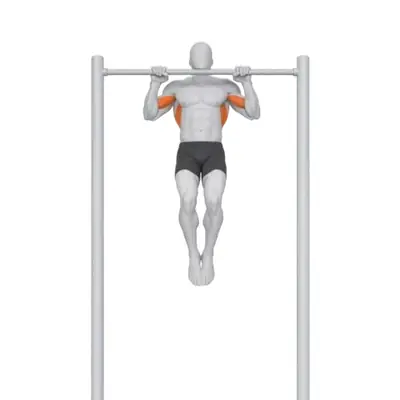
Bodyweight
Steps and tips
Also works biceps.
Hanging from a bar and pulling your chin over it. The bodyweight test of back and arm strength.
How to do it
- Grab the bar with your palms facing away and your hands about shoulder width apart.
- Hang with straight arms. Squeeze your glutes and brace your core so your body stays still.
- Start the pull by drawing your shoulder blades down, then pull your elbows toward your ribs.
- Keep pulling until your chin clears the bar.
- Lower yourself slowly all the way back to straight arms.
Keep in mind
- No kicking or swinging. Momentum steals the work from your back.
- Every rep starts from a full hang and ends with your chin over the bar. Half reps do not count.
- Keep your shoulders down away from your ears, especially at the bottom.
-
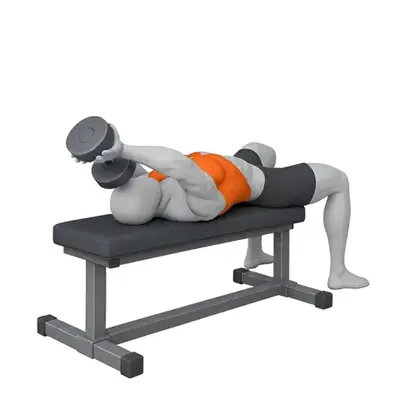
Dumbbell
Steps and tips
Also works chest and triceps.
Lowering a dumbbell behind your head while lying on a bench, then pulling it back over. Works the lats and chest through a deep stretch.
How to do it
- Lie on a flat bench holding one dumbbell with both hands under the top plate, arms nearly straight over your chest.
- Lower the dumbbell in an arc back over your head until you feel a stretch in your lats.
- Pull it back over your chest along the same arc.
Keep in mind
- Keep a slight bend in your elbows and hold it for the whole rep.
- Keep your ribs down and your lower back on the bench.
-
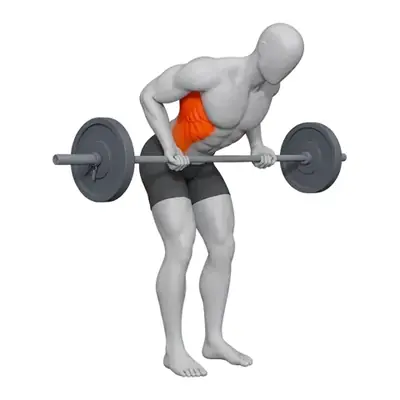
Barbell
Steps and tips
Also works upper back, biceps, lower back and traps.
A bent-over barbell row with your palms facing forward. Pulls to the lower stomach and works the lats with more help from the biceps.
How to do it
- Hold a barbell with your palms facing forward, hands about shoulder width apart.
- Hinge forward with a flat back until your torso is about 45 degrees.
- Row the bar to your lower stomach, keeping your elbows close to your sides.
- Lower it slowly until your arms are straight.
Keep in mind
- Hold the hinge. A rising torso means the bar is too heavy.
- Keep your wrists straight. The underhand grip loads the biceps, so do not let it strain them.
-
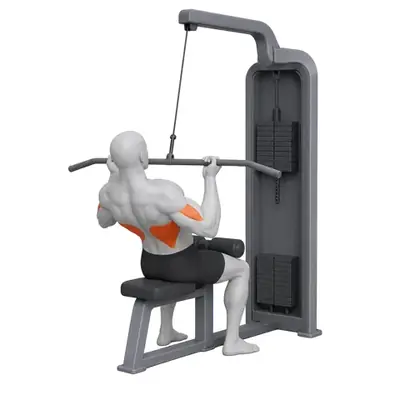
Cable
Steps and tips
Also works biceps.
A lat pulldown with your palms facing you. Works the lats with more help from the biceps.
How to do it
- Sit at the pulldown machine with your thighs under the pads and grip the bar with your palms facing you, about shoulder width apart.
- Start with your arms straight and your chest up.
- Pull the bar down to your upper chest, driving your elbows down and back.
- Let it rise slowly until your arms are straight.
Keep in mind
- Lean back only slightly and hold it.
- Keep your wrists straight rather than curling them at the bottom.
-
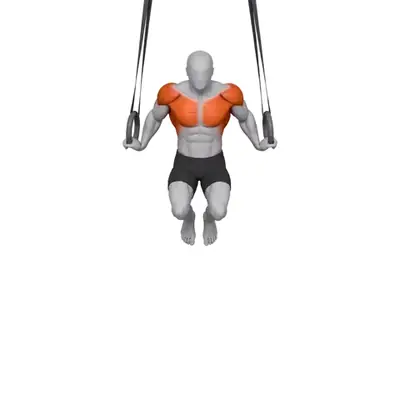
Suspension
Steps and tips
Also works biceps, triceps and chest.
A muscle-up on gymnastic rings, from a hang below to a press out above. Needs a false grip and a strong transition.
How to do it
- Hang from the rings with a false grip, wrists over the rings, and a small swing.
- Pull explosively, bringing the rings to your chest as your body rises.
- Lean forward and push the rings down and back to pass through the transition.
- Press out to straight arms, then lower back through the transition to the hang.
Keep in mind
- Build a strict pull-up with a false grip and a full ring dip first.
- Practise the transition from your feet on low rings before trying it in the air.
-
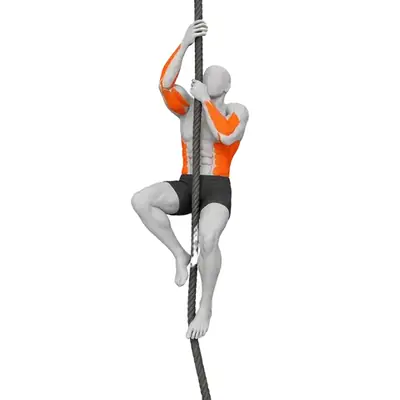
Bodyweight
Steps and tips
Also works biceps and core.
Climbing a rope using your hands and, usually, a foot lock. Builds grip, lats and arms, and is a classic test of pulling strength.
How to do it
- Grip the rope high with both hands and jump to bring your knees up.
- Wrap the rope around one leg and pinch it between your feet to lock it.
- Stand up on the lock while reaching your hands higher, then re-lock the rope higher up.
- Repeat to the top, then lower hand under hand with the feet controlling the descent.
Keep in mind
- Your legs do the climbing. If your arms are burning after one climb, the foot lock is not holding.
- Never slide down. It burns the hands and skips the control.
-
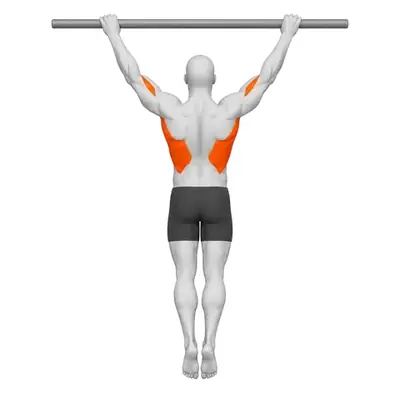
Bodyweight
Steps and tips
Also works traps.
Hanging from a bar and pulling your shoulder blades down without bending your arms. Teaches the first inch of every pull-up.
How to do it
- Hang from the bar with straight arms and let your shoulders relax up toward your ears.
- Keeping your arms straight, pull your shoulder blades down and back so your body rises an inch or two.
- Hold for a second at the top.
- Relax slowly back to the full hang.
Keep in mind
- Arms stay completely straight. If your elbows bend, it has become a pull-up.
- Small movement, done well. It should feel like your lats are squeezing.
-
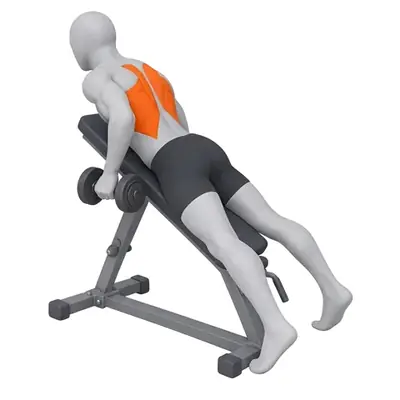
Dumbbell
Steps and tips
Also works upper back, biceps and rear delts.
A one-arm row lying face down on an incline bench. The bench takes the lower back out of it, so the lats and upper back do all the work.
How to do it
- Set a bench to about 45 degrees and lie face down on it with a dumbbell in one hand hanging straight down.
- Keep your chest on the pad and your free hand on the bench.
- Row the dumbbell to your ribs, driving your elbow back and squeezing your shoulder blade.
- Lower slowly until your arm is straight. Finish the set, then switch sides.
Keep in mind
- Keep your chest on the pad. Lifting off it is the lower back helping.
- Log reps for one side. SetLift counts the other side for you.
-
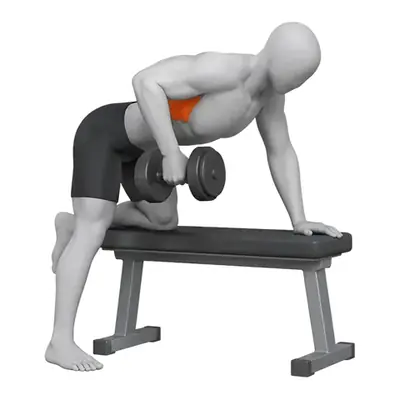
Dumbbell
Steps and tips
Also works upper back, biceps, rear delts and traps.
A one-arm row with a hand and knee on a bench for support. The classic dumbbell back exercise, working the lats and upper back.
How to do it
- Put one knee and the same-side hand on a bench, with your other foot on the floor and a dumbbell in your free hand.
- Keep your back flat and level with the floor, and let the dumbbell hang straight down.
- Row the dumbbell to your hip, driving your elbow up and back close to your body.
- Lower slowly until your arm is straight. Finish the set, then switch sides.
Keep in mind
- Keep your torso still and square to the floor. Twisting open at the top is momentum.
- Pull to the hip, not the shoulder. That is what keeps it on the lats.
- Log reps for one side. SetLift counts the other side for you.
-
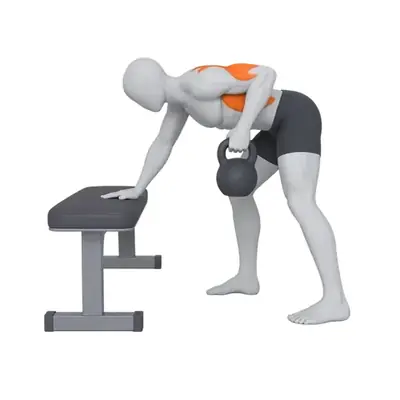
Kettlebell
Steps and tips
Also works upper back, biceps, rear delts and traps.
A one-arm row with a kettlebell, supported on a bench or in a split stance. Works the lats and upper back one side at a time.
How to do it
- Put a hand and knee on a bench, or take a split stance with your free hand on your front thigh, and hold the bell in your free hand.
- Keep your back flat and let the bell hang straight down.
- Row the bell to your hip, driving your elbow up and back close to your body.
- Lower slowly until your arm is straight. Finish the set, then switch sides.
Keep in mind
- Keep your torso square. Do not twist open to lift the bell higher.
- Log reps for one side. SetLift counts the other side for you.
-
Barbell
Steps and tips
Also works biceps.
A one-arm row on the end of a landmine barbell, standing beside it in a hinge. Works the lats through a big range.
How to do it
- Stand beside the end of the anchored bar, hinge forward with a flat back, and grip the bar behind the collar with the near hand.
- Rest your free hand on your thigh for support.
- Row the bar to your hip, driving your elbow up and back.
- Lower slowly until your arm is straight. Finish the set, then switch sides.
Keep in mind
- Hold the hinge for the whole set.
- Log reps for one side. SetLift counts the other side for you.
-
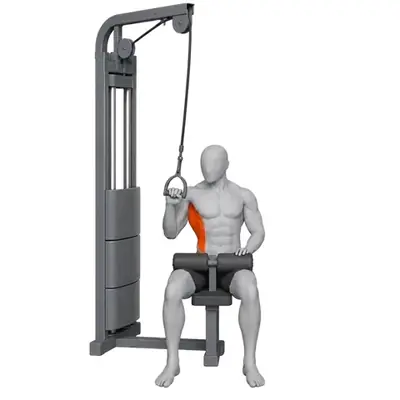
Cable
Steps and tips
Also works biceps, rear delts and upper back.
A lat pulldown with one hand on a single handle. Works each lat on its own and lets you feel the muscle work.
How to do it
- Attach a single handle to the high pulley and sit or kneel facing the machine.
- Grip the handle with one hand, arm straight, and your chest up.
- Pull the handle down to the side of your chest, driving your elbow down and back.
- Let it rise slowly until your arm is straight. Finish the set, then switch sides.
Keep in mind
- Keep your torso still. Leaning away from the working side is the common cheat.
- Log reps for one side. SetLift counts the other side for you.
-
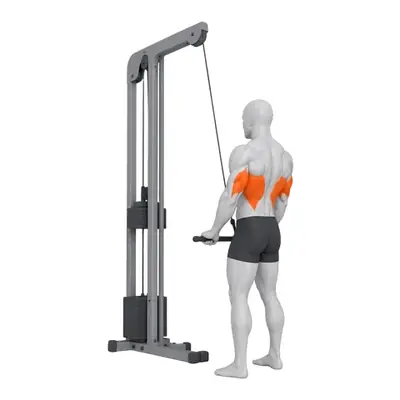
Cable
Steps and tips
Pulling a high cable down to your thighs with straight arms. Works the lats on their own, with the arms kept out of it.
How to do it
- Set the pulley high with a straight bar or rope and stand facing it, holding the attachment with straight arms above shoulder height.
- Step back until the weight is off the stack and hinge slightly forward.
- Pull your straight arms down in an arc until your hands reach your thighs.
- Let them return slowly to the start.
Keep in mind
- A soft elbow that never changes. Bending the arms turns it into a pushdown.
- Feel your lats squeeze at the bottom. If it is all in your arms, lighten the weight.
-
Suspension
Steps and tips
Also works upper back, biceps and obliques.
A one-arm row on a suspension strap that rotates your body toward the anchor as you pull. Works the lats and upper back with the core steering.
How to do it
- Face the anchor holding one handle, with your free arm reaching up along the strap toward the anchor.
- Lean back with your arm straight and let your free arm swing down and back, turning your body away.
- Row yourself up, turning back toward the anchor and reaching your free hand up the strap again.
- Lower slowly and repeat. Finish the set, then switch arms.
Keep in mind
- The rotation comes from your whole body, not just the shoulders.
- Walk your feet forward to make it harder.
-
Suspension
Steps and tips
Also works shoulders.
Leaning back into suspension straps and pulling your straight arms down to your hips, like a swimming stroke. Works the lats and the back of the shoulders.
How to do it
- Face the anchor holding a handle in each hand and lean back with your arms straight and raised in front of you.
- Keep your body in one straight line from head to heels.
- Pull your straight arms down and back until your hands are beside your hips, lifting your body toward upright.
- Return slowly to the start.
Keep in mind
- Arms stay straight. Bending them makes it a row.
- Walk your feet forward to make it harder.
-
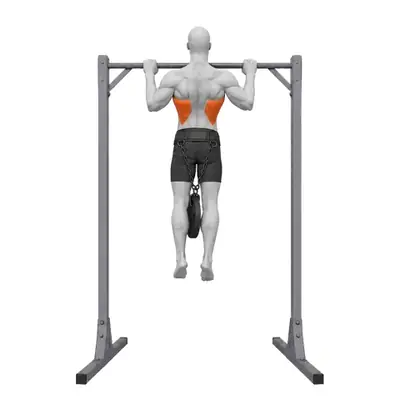
Bodyweight
Steps and tips
Also works biceps.
A pull-up with extra weight on a belt, between your feet, or in a vest. The way to keep pull-ups building strength once bodyweight is easy.
How to do it
- Hang the weight from a dip belt, hold a dumbbell between your feet, or put on a vest.
- Grab the bar with an overhand grip a little wider than your shoulders and hang with straight arms.
- Pull your elbows down and back until your chin clears the bar.
- Lower slowly all the way back to straight arms.
Keep in mind
- Strict form only. Added weight and a kip is how shoulders get hurt.
- Log the added weight. SetLift counts your body weight for you.
-
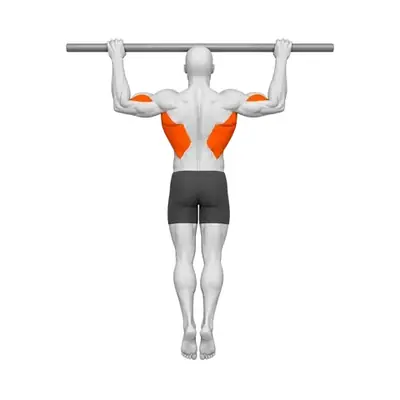
Bodyweight
Steps and tips
Also works biceps.
A pull-up with the hands set well wider than the shoulders. Shortens the range and puts more of the work on the lats.
How to do it
- Grab the bar with an overhand grip well wider than your shoulders and hang with straight arms.
- Brace your core and keep your body still.
- Pull your elbows down and out until your chin clears the bar.
- Lower slowly all the way back to straight arms.
Keep in mind
- Do not go so wide that your shoulders ache. About one and a half times shoulder width is plenty.
- Full hang at the bottom every rep.
Upper Back 25
-
Band
Steps and tips
Also works biceps.
A bent-over row against a band held under your feet. Works the upper back and lats anywhere.
How to do it
- Stand on the middle of a band with your feet about hip width apart and hold an end in each hand.
- Hinge forward with a flat back until your torso is about 45 degrees.
- Row your hands to your ribs, driving your elbows back and squeezing your shoulder blades together.
- Return slowly until your arms are straight.
Keep in mind
- Hold the hinge. Standing up as you pull is the band winning.
- Wider feet mean more tension.
-
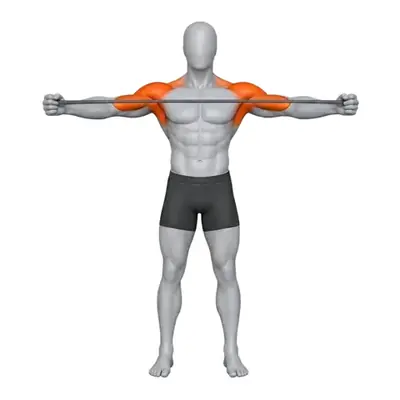
Band
Steps and tips
Also works rear delts.
Pulling a band apart in front of you with straight arms. Works the upper back and rear shoulders, and is a great warm-up for pressing.
How to do it
- Hold a band in front of you at shoulder height with your hands about shoulder width apart and your arms straight.
- Pull your hands apart until the band touches your chest.
- Squeeze your shoulder blades together for a moment.
- Return slowly to the start.
Keep in mind
- Arms stay straight. Bending them makes it a row.
- Keep your shoulders down and your ribs down. Do not arch to finish.
-
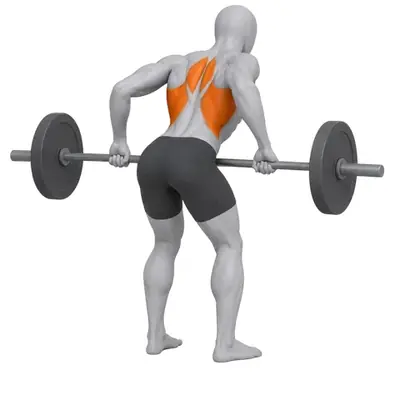
Barbell
Steps and tips
Also works biceps.
Rowing a barbell to your body from a bent-over position. The main barbell back exercise, working the upper back and lats.
How to do it
- Hold a barbell with an overhand grip a little wider than your shoulders.
- Hinge forward with a flat back until your torso is about 45 degrees, knees slightly bent, bar hanging below your chest.
- Row the bar to your lower ribs, driving your elbows back.
- Squeeze your shoulder blades together, then lower the bar slowly until your arms are straight.
Keep in mind
- Hold the hinge for the whole set. If your torso rises to meet the bar, it is too heavy.
- Keep your back flat and your neck in line with it.
- Drive the elbows, not the hands. Think of your hands as hooks.
-
Dumbbell
Steps and tips
Also works biceps.
A bent-over dumbbell row with the elbows out wide, pulling toward the chest. Works the upper back and rear shoulders.
How to do it
- Hold a dumbbell in each hand and hinge forward with a flat back until your torso is nearly level with the floor.
- Let the dumbbells hang below your chest with your palms facing back.
- Row them up with your elbows going out wide, until your upper arms are level with your back.
- Squeeze your shoulder blades together, then lower slowly.
Keep in mind
- Elbows out wide is what makes it an upper back exercise. Tucked elbows make it a lat row.
- Keep your torso still.
-
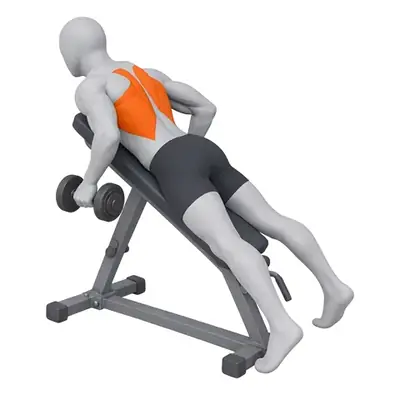
Dumbbell
Steps and tips
Also works biceps.
A dumbbell row lying face down on an incline bench. The bench holds you still, so the upper back and lats do all the work.
How to do it
- Set a bench to about 45 degrees and lie face down on it with a dumbbell in each hand hanging straight down.
- Keep your chest on the pad and your neck neutral.
- Row both dumbbells to your ribs, driving your elbows back and squeezing your shoulder blades.
- Lower slowly until your arms are straight.
Keep in mind
- Keep your chest glued to the pad. Lifting off it is the lower back helping.
- A full stretch at the bottom of every rep.
-
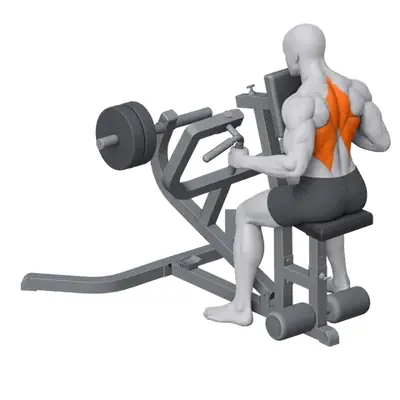
MachinePlate-Loaded
Steps and tips
Also works biceps.
A row on a plate-loaded machine with a pad for your chest. The pad takes the lower back out of it, so the upper back gets all the work.
How to do it
- Load the plates, then set the seat so the pad sits against your chest and the handles are within reach.
- Grip the handles with your arms straight.
- Row the handles back to your ribs, driving your elbows back and squeezing your shoulder blades.
- Let them return slowly until your arms are straight.
Keep in mind
- Keep your chest on the pad the whole set.
- Squeeze at the end of every rep rather than bouncing off the stretch.
-
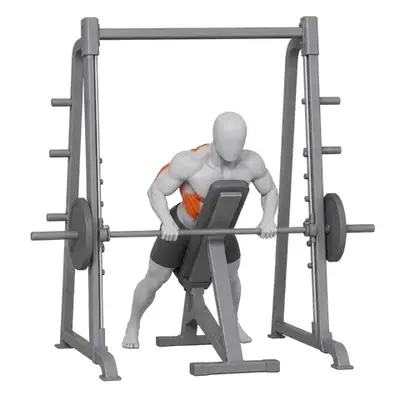
Machine
Steps and tips
Also works lats and biceps.
A row on the Smith machine with your chest on an incline bench set under the bar. Works the upper back and lats with the lower back out of it.
How to do it
- Set an incline bench under the bar so that, lying face down, you can reach the bar with straight arms.
- Lie on the bench, grip the bar a little wider than your shoulders, and unhook it.
- Row the bar up toward the bench, driving your elbows back.
- Lower slowly until your arms are straight.
Keep in mind
- Keep your chest on the pad for every rep.
- Line the bench up before loading. The bar cannot move to meet you.
-
Cable
Steps and tips
Also works biceps.
A standing row on a cable machine with the cables crossed, so each hand pulls the opposite pulley. Works the upper back with a wider pull.
How to do it
- Set both pulleys at chest height and grab the left handle with your right hand and the right handle with your left, so the cables cross.
- Step back into a staggered stance until the weight is off the stack, arms straight in front of you.
- Row both handles back to your ribs, driving your elbows back and squeezing your shoulder blades.
- Let them return slowly until your arms are straight.
Keep in mind
- Stand tall and braced. The cables will try to pull you forward.
- Keep your shoulders down away from your ears.
-
KettlebellDumbbell
Steps and tips
Also works lats and core.
Rowing two kettlebells from the floor one at a time while bent over, the other bell staying on the floor. Works the upper back and lats with the core holding you square.
How to do it
- Stand with two kettlebells on the floor between your feet and hinge down to grip both handles, back flat.
- Row one bell up to your hip while pushing down into the other bell on the floor.
- Lower it to the floor, then row the other side.
- Keep alternating for the set.
Keep in mind
- Stay in the hinge the whole set. Standing up between reps is the common cheat.
- Push down into the resting bell to keep your torso square.
-
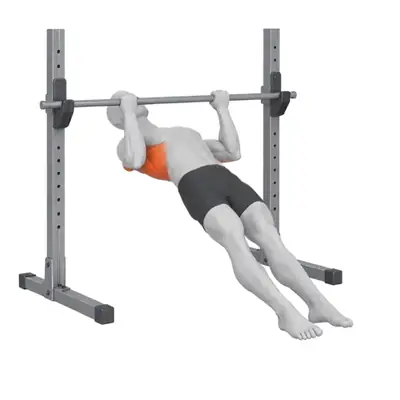
Bodyweight
Steps and tips
Also works biceps.
Pulling your chest up to a bar set at waist height while your body hangs straight below it. A bodyweight row for the upper back.
How to do it
- Set a bar at about waist height and lie under it, gripping it a little wider than your shoulders.
- Straighten your body from head to heels, with your heels on the floor.
- Pull your chest up to the bar, driving your elbows back.
- Lower slowly until your arms are straight.
Keep in mind
- Keep your body in one line. Sagging hips are the most common fault.
- A lower bar or raised feet makes it harder, a higher bar easier.
-
Barbell
Steps and tips
Also works traps.
A shrug done bent over or with your chest on a bench, pulling your shoulder blades back and together without bending your arms. Works the middle of the upper back.
How to do it
- Lie face down on an incline bench, or hinge forward, with a dumbbell in each hand and your arms hanging straight down.
- Keeping your arms straight, pull your shoulder blades back and together.
- Hold the squeeze for a second at the top.
- Let your shoulder blades spread apart slowly.
Keep in mind
- Arms stay straight the whole time. The movement is all in the shoulder blades.
- Think of squeezing a pencil between your shoulder blades.
-
Barbell
Steps and tips
Also works biceps.
A one-arm row on the end of a landmine barbell with an overhand grip and a staggered stance. Works the upper back and lats through a long range.
How to do it
- Stand beside the end of the anchored bar in a staggered stance, and hinge forward with a flat back.
- Grip the very end of the bar with an overhand grip, elbow out.
- Row the bar up, driving your elbow out and back until it is level with your back.
- Lower slowly until your arm is straight. Finish the set, then switch sides.
Keep in mind
- Elbow out, not tucked. That is what separates it from a normal landmine row.
- Log reps for one side. SetLift counts the other side for you.
-
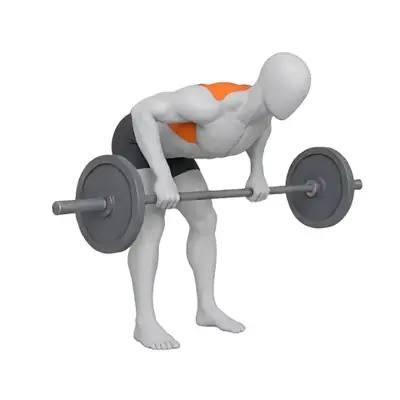
Barbell
Steps and tips
Also works biceps.
A barbell row where the bar starts and finishes on the floor every rep, with your torso level with the floor. A strict, explosive row for the upper back.
How to do it
- Stand over the bar with your feet about hip width apart and hinge down until your torso is level with the floor.
- Grip the bar a little wider than your shoulders with your back flat.
- Row the bar hard to your lower chest, keeping your torso still.
- Lower it all the way back to the floor and let it settle before the next rep.
Keep in mind
- Every rep starts from a dead stop. No bouncing off the floor.
- Torso stays level with the floor. If it rises, the bar is too heavy.
-
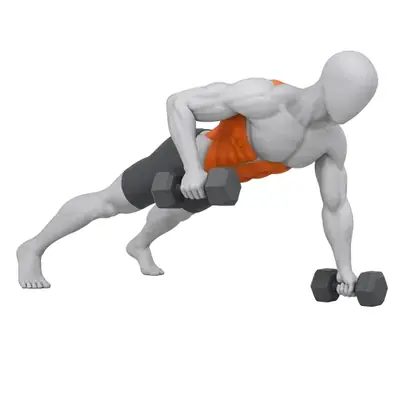
Dumbbell
Steps and tips
Also works chest, shoulders, biceps, lats, lower back and core.
A plank on two dumbbells, rowing one at a time. Works the upper back and lats while the whole body holds a plank.
How to do it
- Get into a push-up position with a hand on each dumbbell and your feet wide for balance.
- Brace your core and squeeze your glutes so your hips stay level.
- Row one dumbbell to your ribs, keeping your hips square, then lower it.
- Row the other side. Keep alternating for the set.
Keep in mind
- The plank is the exercise as much as the row. Do not let your hips rotate.
- Log the total reps. Each row counts as one.
-
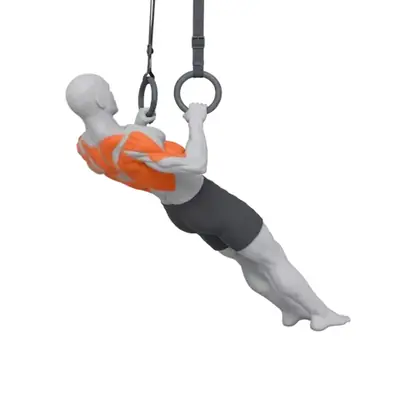
Suspension
Steps and tips
Also works lats and biceps.
An inverted row on gymnastic rings. The rings let your wrists turn as you pull, which is kinder to the shoulders.
How to do it
- Set the rings at about waist height and lie under them, gripping them with straight arms.
- Straighten your body from head to heels with your heels on the floor.
- Pull your chest up to the rings, turning your palms toward you as you rise.
- Lower slowly until your arms are straight.
Keep in mind
- Keep your body in one line. Sagging hips are the most common fault.
- Lower rings or raised feet make it harder.
-
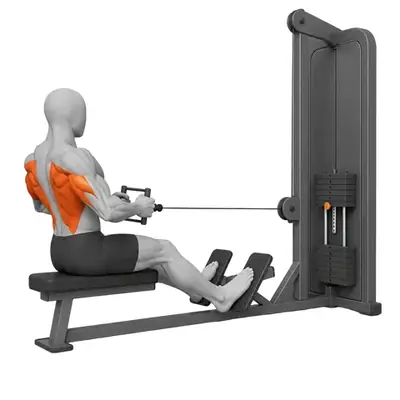
Cable
Steps and tips
Also works biceps.
A seated row on a low cable, usually with a V handle. The basic machine row for the upper back and lats.
How to do it
- Sit at the machine with your feet on the platform and a slight bend in your knees, and grip the handle.
- Sit tall with your arms straight and your shoulders down.
- Row the handle to your lower ribs, driving your elbows back and squeezing your shoulder blades.
- Let it return slowly until your arms are straight.
Keep in mind
- Sit tall the whole set. Rocking back and forth is momentum, not back.
- Squeeze at the end of every rep, then a full stretch without rounding your back.
-
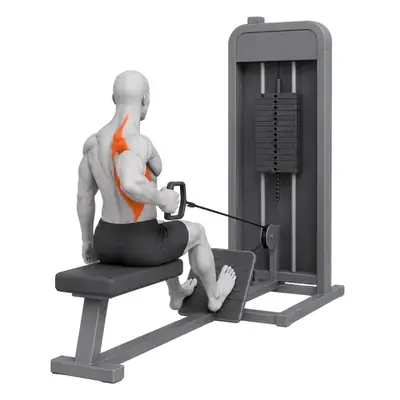
Cable
Steps and tips
Also works lats and biceps.
A seated cable row with one handle, pulling with one arm at a time. Works the upper back and lats, and lets each side work on its own.
How to do it
- Sit at the cable row station with your feet on the platform and hold one handle with your arm straight.
- Sit tall and brace so your torso stays square to the machine.
- Pull the handle to your lower ribs, driving the elbow back and squeezing the shoulder blade.
- Let the arm straighten slowly. Finish the set, then switch arms.
Keep in mind
- Keep both shoulders facing forward. Twisting toward the working arm is the common fault.
- Drive the elbow back rather than curling the handle with the biceps.
-
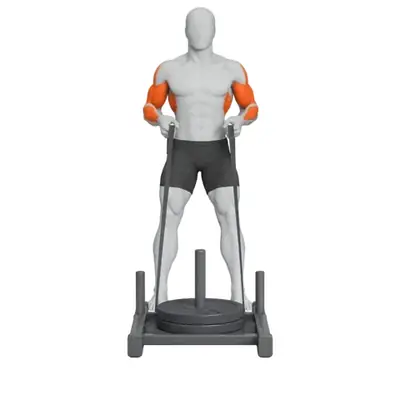
Sled
Steps and tips
Also works lats and biceps.
Rowing a sled toward you on a strap or rope, hand over hand or with both arms together. A back exercise with no lowering half.
How to do it
- Attach a strap or rope to the sled and stand facing it in a half squat, holding the strap with straight arms.
- Brace your core and keep your chest up.
- Row the strap to your ribs, driving your elbows back, and let the sled slide toward you.
- Step back to take up the slack and repeat.
Keep in mind
- Stay low in your legs. Standing up tall lets your lower back take over.
- Count each pull as a rep.
-
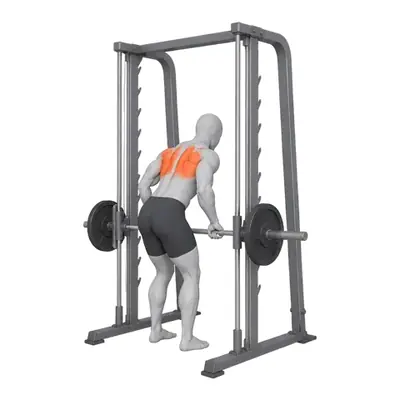
Machine
Steps and tips
Also works lats and biceps.
A bent-over row on the Smith machine. The fixed bar path makes it easy to hold a strict hinge and load the upper back.
How to do it
- Stand with the bar in front of you and hinge forward with a flat back until your torso is about 45 degrees.
- Grip the bar a little wider than your shoulders and unhook it.
- Row the bar to your lower ribs, driving your elbows back.
- Lower slowly until your arms are straight.
Keep in mind
- Hold the hinge for the whole set.
- Squeeze your shoulder blades together at the top of every rep.
-
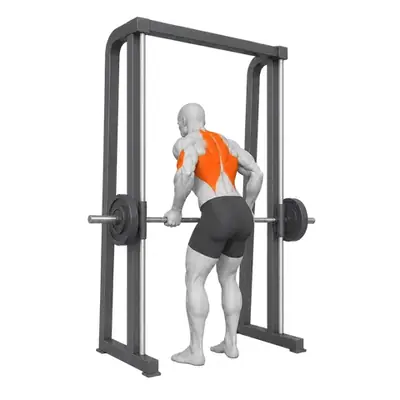
Machine
Steps and tips
Also works lats and biceps.
A bent-over row on the Smith machine with your palms facing forward. Pulls to the lower stomach and works the upper back and lats with more help from the biceps.
How to do it
- Stand with the bar in front of you and hinge forward with a flat back until your torso is about 45 degrees.
- Grip the bar with your palms facing forward, about shoulder width apart, and unhook it.
- Row the bar to your lower stomach, keeping your elbows close to your sides.
- Lower slowly until your arms are straight.
Keep in mind
- Hold the hinge. A rising torso means the bar is too heavy.
- Keep your wrists straight.
-
Cable
Steps and tips
Also works biceps and lower back.
A standing row on a low cable from a split stance. Works the upper back and lats while the legs and core hold you still.
How to do it
- Set the pulley low, hold the handle, and step back into a split stance with one foot forward.
- Hinge slightly forward with a flat back and your arms straight toward the pulley.
- Row the handle to your lower ribs, driving your elbows back.
- Let it return slowly until your arms are straight.
Keep in mind
- Keep your torso angle the same for the whole set.
- Switch your front foot halfway through the set, or between sets.
-
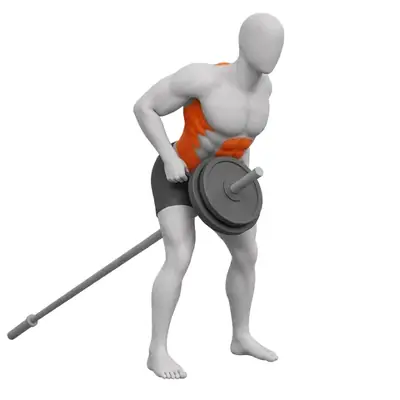
Barbell
Steps and tips
Also works biceps.
A row on a bar anchored at one end. Builds the middle of the back and the lats, with the biceps helping.
How to do it
- Stand over the bar with your feet about shoulder width apart, and grip the handles.
- Push your hips back and bend your knees slightly so your torso is angled at roughly 45 degrees. Keep your back flat.
- Brace your core, then pull the handles toward your lower chest, driving your elbows back.
- Squeeze your shoulder blades together at the top and pause.
- Lower the weight slowly until your arms are straight and your back gets a full stretch.
Keep in mind
- Keep your torso at the same angle for the whole set. Heaving up with your hips means the weight is too heavy.
- Never let your back round. Chest up, spine flat.
- Standing too tall turns this into an arm exercise. Stay hinged over the bar.
-
Suspension
Steps and tips
Also works rear delts.
Leaning back into suspension straps and opening your straight arms out to the sides. Works the upper back and rear shoulders.
How to do it
- Face the anchor holding a handle in each hand and lean back with your arms straight in front of you.
- Keep your body in one straight line from head to heels.
- Open your straight arms out to the sides until your body is upright and your arms make a T.
- Return slowly to the start.
Keep in mind
- Arms stay straight. Bending them makes it a row.
- Walk your feet forward to make it harder.
-
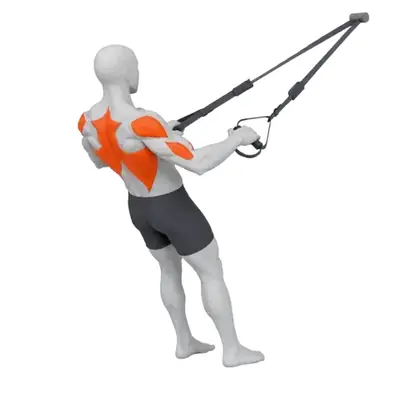
Suspension
Steps and tips
Also works biceps.
A row on suspension straps, pulling your chest to your hands while your body hangs in a straight line. A bodyweight row you can make harder by moving your feet.
How to do it
- Face the anchor holding a handle in each hand and lean back until your arms are straight.
- Keep your body in one straight line from head to heels.
- Row your chest to your hands, driving your elbows back and squeezing your shoulder blades.
- Lower slowly until your arms are straight.
Keep in mind
- Keep your hips up in line with your body. Sagging is the common fault.
- Walk your feet forward under the anchor to make it harder.
-
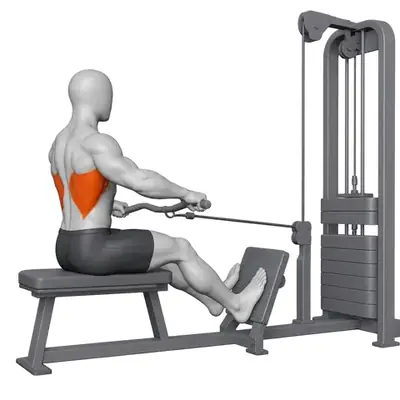
Cable
Steps and tips
Also works rear delts and biceps.
A seated cable row with a wide bar and the elbows out. Works the upper back and rear shoulders more than a close row.
How to do it
- Sit at the machine with your feet on the platform and grip a wide bar with an overhand grip.
- Sit tall with your arms straight and your shoulders down.
- Row the bar to your upper stomach with your elbows out wide, squeezing your shoulder blades together.
- Let it return slowly until your arms are straight.
Keep in mind
- Elbows out wide, not tucked. That is what moves the work to the upper back.
- Sit tall and still. No rocking.
Lower Back 12
-
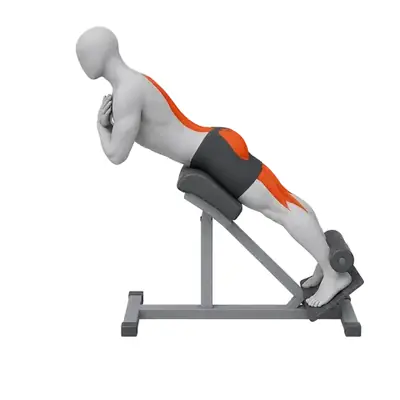
BodyweightMachine
Steps and tips
Also works glutes and hamstrings.
Lifting your torso from a bent position on a back extension bench. Works the lower back, glutes and hamstrings.
How to do it
- Set the pad so it sits just below your hips, and hook your heels under the rollers.
- Cross your arms over your chest or hold them at your sides.
- Lower your torso slowly until it is below the line of your legs.
- Raise it back up until your body makes one straight line. Do not go higher.
Keep in mind
- Stop when your body is straight. Arching past that strains the lower back.
- Squeeze your glutes at the top to share the work.
-
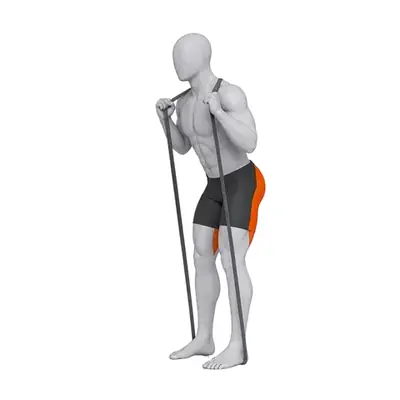
Band
Steps and tips
Also works hamstrings.
A hip hinge against a band across the back of your neck and under your feet. Works the hamstrings and lower back.
How to do it
- Stand on a band with your feet about shoulder width apart and loop the other end across the back of your neck and shoulders.
- Soften your knees and keep your back flat.
- Push your hips back and hinge forward until you feel a stretch in your hamstrings.
- Drive your hips forward to stand back up.
Keep in mind
- The knees stay softly bent and the back stays flat. It is a hinge, not a bow.
- Wider feet mean more tension from the band.
-
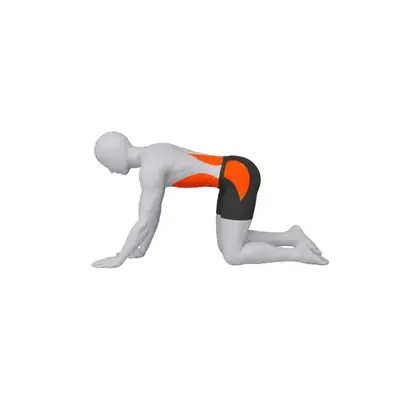
Bodyweight
Steps and tips
Also works core and glutes.
Reaching one arm forward and the opposite leg back from all fours. Trains the lower back and core to stay still while the limbs move.
How to do it
- Start on your hands and knees with your hands under your shoulders and your knees under your hips.
- Brace your core so your back stays flat.
- Reach one arm straight forward and the opposite leg straight back at the same time.
- Hold for a second, return, and repeat on the other side.
Keep in mind
- Keep your hips level. The common fault is twisting to lift the leg higher.
- Reach long rather than high. The leg should be level with your back, not above it.
-
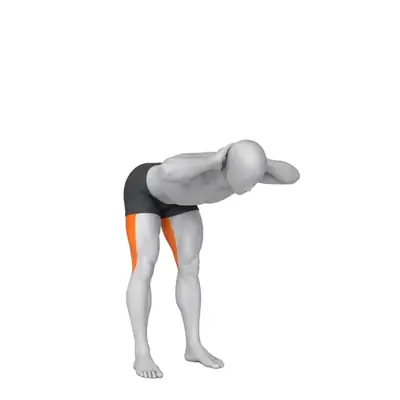
Bodyweight
Steps and tips
Also works hamstrings and glutes.
A hip hinge with your hands behind your head and no weight. Teaches the hinge and warms up the hamstrings and lower back.
How to do it
- Stand with your feet about shoulder width apart and your hands behind your head.
- Soften your knees and keep your back flat.
- Push your hips back and hinge forward until you feel a stretch in your hamstrings.
- Drive your hips forward to stand back up.
Keep in mind
- Push the hips back first. If your knees bend a lot, it has become a squat.
- Keep your chest up and your neck in line with your back.
-
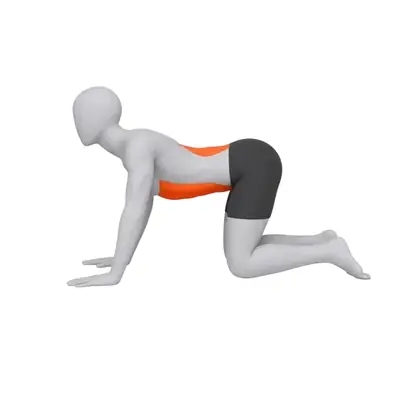
Bodyweight
Steps and tips
Also works core.
Rounding your back up toward the ceiling, then letting it sag while your chest lifts, from all fours. A gentle mobility drill for the whole spine.
How to do it
- Start on your hands and knees with your hands under your shoulders and your knees under your hips.
- Breathe out and round your back up toward the ceiling, tucking your tailbone and letting your head drop.
- Breathe in and reverse it: let your belly sink, lift your chest and tailbone, and look slightly forward.
- Move slowly between the two shapes, one breath per position, for the set.
Keep in mind
- Let your breath set the pace. Rushing between the two positions misses the point.
- Move the whole spine, neck included, rather than just the lower back.
-
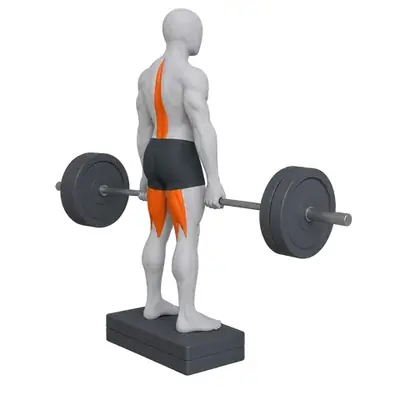
Barbell
Steps and tips
Also works glutes, hamstrings, lats, quads and traps.
A deadlift standing on a low platform, so the bar starts lower than usual. Builds strength off the floor with a longer pull.
How to do it
- Stand on a plate or low platform with the bar over the middle of your feet.
- Hinge down with a flat back and grip the bar just outside your legs.
- Brace, then stand up by pushing the floor away, keeping the bar close to your legs.
- Lock out at the top, then lower the bar under control back to the floor.
Keep in mind
- The extra range makes it easier to round your back at the start. Keep your chest up and go lighter than your normal deadlift.
- A small deficit, one to two inches, is plenty.
-
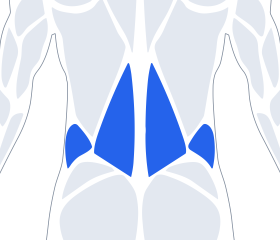
BodyweightMachine
Steps and tips
Also works glutes and hamstrings.
A back extension on the glute-ham developer, with your hips on the pad and your feet locked in. Works the lower back, glutes and hamstrings.
How to do it
- Set the pad so it sits just below your hips, and lock your feet in behind the rollers.
- Cross your arms over your chest.
- Lower your torso slowly until it hangs below the line of your legs.
- Raise it back up until your body makes one straight line.
Keep in mind
- Stop when your body is straight. Do not arch past it.
- Squeeze your glutes to finish each rep.
-
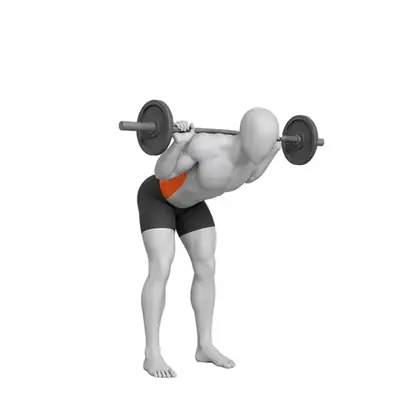
Barbell
Steps and tips
Also works hamstrings and glutes.
A hip hinge with a barbell on your upper back. Works the hamstrings and lower back, and builds the hinge for deadlifts and squats.
How to do it
- Stand with the bar on your upper back, feet about shoulder width apart, and a soft bend in your knees.
- Brace your core and keep your back flat.
- Push your hips back and hinge forward until your torso is about 45 degrees or you feel a stretch in your hamstrings.
- Drive your hips forward to stand back up.
Keep in mind
- Keep the bar tight on your back and the hinge slow. Light weight is right here.
- If your lower back rounds, you have gone too low.
-
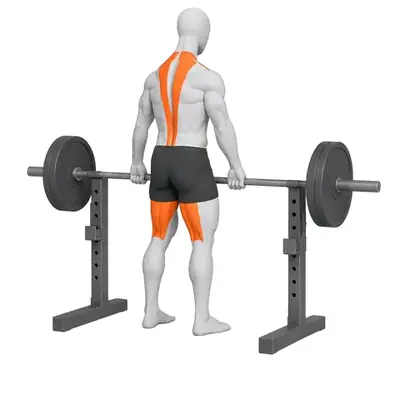
Barbell
Steps and tips
Also works hamstrings and glutes.
A deadlift from rack pins set at or above the knees. Works the lower back, glutes and traps with heavier weight than a full deadlift.
How to do it
- Set the pins so the bar sits at about knee height and stand with the bar over the middle of your feet.
- Hinge down with a flat back and grip the bar just outside your legs.
- Brace, then stand up by driving your hips forward, keeping the bar against your legs.
- Lock out with your glutes, then lower the bar under control back to the pins.
Keep in mind
- Let the bar settle on the pins before each rep. Bouncing off the pins is not a rep.
- Keep your shoulders back at the top. No leaning back past upright.
-
MachineBodyweight
Steps and tips
Also works glutes and hamstrings.
Lying face down on a high bench and swinging your legs up behind you. Works the glutes and lower back with the spine unloaded.
How to do it
- Lie face down on the reverse hyper or a high bench with your hips at the edge and your legs hanging down.
- Hold the handles or the bench for support.
- Raise your legs behind you until they are level with your body, squeezing your glutes.
- Lower them slowly and let them swing under the bench.
Keep in mind
- Lift with the glutes, not by arching your back. Stop when your legs are level with your body.
- Slow and controlled beats big swings.
-
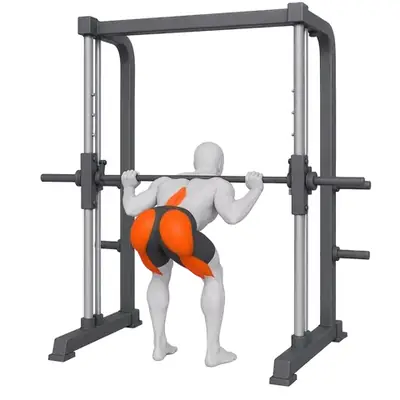
Machine
Steps and tips
Also works hamstrings and glutes.
A good morning on the Smith machine. The fixed bar path lets you focus on the hinge without balancing the bar.
How to do it
- Stand with the bar on your upper back, feet about shoulder width apart, and unhook it.
- Soften your knees and keep your back flat.
- Push your hips back and hinge forward until you feel a stretch in your hamstrings.
- Drive your hips forward to stand back up.
Keep in mind
- Stand a little forward of the bar so the fixed path matches your hinge.
- Keep it light. This is a hinge exercise, not a load exercise.
-
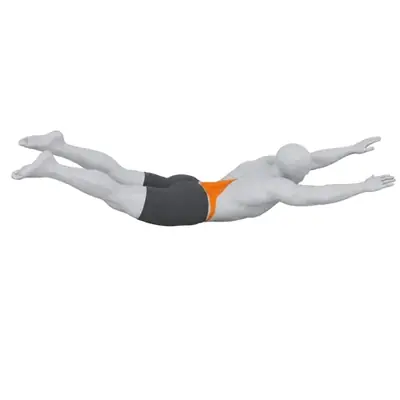
Bodyweight
Steps and tips
Also works glutes.
Lying face down and lifting your arms and legs off the floor at the same time. A bodyweight exercise for the lower back and glutes.
How to do it
- Lie face down with your arms stretched out in front of you and your legs straight.
- Lift your arms, chest and legs off the floor at the same time.
- Hold for a second at the top, squeezing your glutes.
- Lower slowly back to the floor.
Keep in mind
- Look at the floor to keep your neck neutral.
- Small lifts, done slowly. Height is not the goal.
Traps 11
-
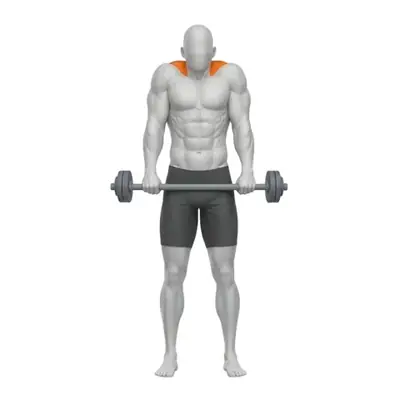
Barbell
Steps and tips
Lifting your shoulders straight up toward your ears while holding a barbell. The basic trap builder.
How to do it
- Stand tall holding a barbell in front of your thighs with your hands about shoulder width apart.
- Keep your arms straight and your chest up.
- Shrug your shoulders straight up as high as they will go.
- Pause at the top, then lower slowly.
Keep in mind
- Straight up and down. Rolling the shoulders in circles does nothing extra and can irritate them.
- Do not bend your elbows to lift the bar higher. That is the biceps cheating.
-
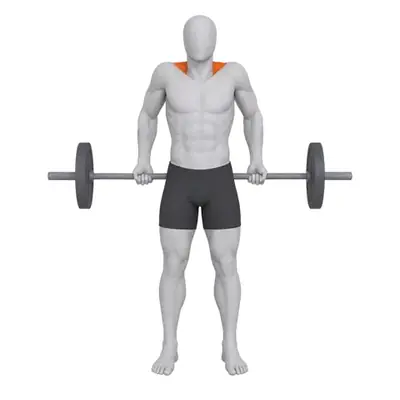
Barbell
Steps and tips
Also works upper back.
A shrug with the barbell held behind your body. Works the traps with the shoulders pulled slightly back.
How to do it
- Stand tall with a barbell behind your thighs, holding it with an overhand grip about shoulder width apart.
- Keep your arms straight and your chest up.
- Shrug your shoulders straight up as high as they will go.
- Pause at the top, then lower slowly.
Keep in mind
- Take the bar from a rack set at thigh height rather than picking it up off the floor behind you.
- Keep the bar close to your body so it does not pull your shoulders back too far.
-
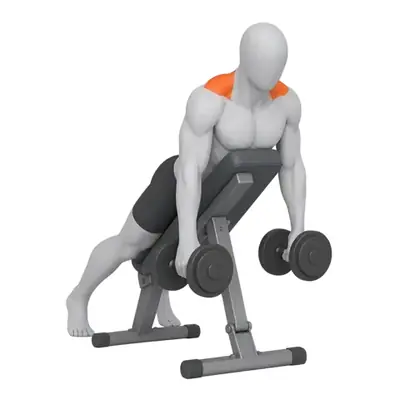
Dumbbell
Steps and tips
Also works rear delts and upper back.
A shrug lying face down on an incline bench with dumbbells. Takes the lower back out of it and works the traps and upper back.
How to do it
- Set a bench to about 45 degrees and lie face down on it with a dumbbell in each hand hanging straight down.
- Keep your arms straight and your chest on the pad.
- Shrug your shoulders up and back toward your ears.
- Pause at the top, then lower slowly.
Keep in mind
- Arms stay straight. Bending the elbows makes it a row.
- Squeeze your shoulder blades together at the top for the upper back.
-
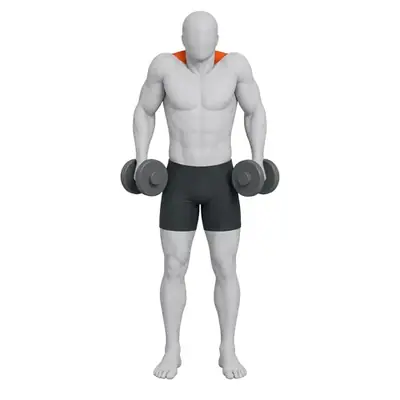
Dumbbell
Steps and tips
Lifting your shoulders toward your ears while holding a dumbbell in each hand. Works the traps.
How to do it
- Stand tall with a dumbbell in each hand at your sides, arms straight.
- Shrug your shoulders straight up as high as they will go.
- Pause at the top for a moment.
- Lower slowly back down.
Keep in mind
- Straight up, not in circles.
- Keep your arms straight. If your elbows bend, the weight is too heavy.
-
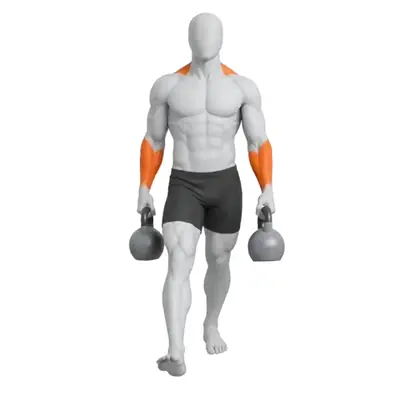
DumbbellKettlebell
Steps and tips
Also works forearms and core.
Walking with a heavy weight in each hand. Builds grip, traps and a rock-solid trunk.
How to do it
- Stand between two dumbbells or kettlebells, hinge down, and pick them up with a strong grip.
- Stand tall with your shoulders back and down and your core braced.
- Walk with short quick steps, keeping the weights still at your sides.
- Log the distance you covered.
Keep in mind
- Stand tall the whole way. Leaning to one side or rounding forward is the sign to drop the weight.
- Set the weights down with a hinge, not a rounded back.
-
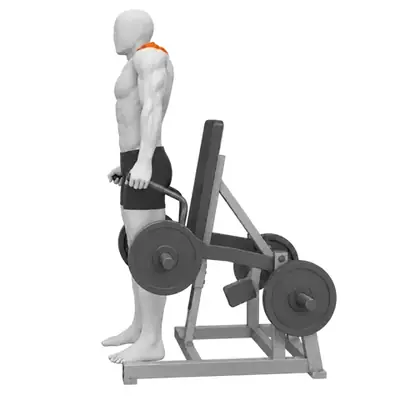
MachinePlate-Loaded
Steps and tips
A shrug on a plate-loaded shrug machine, with the handles at your sides. Works the traps with a fixed path and no grip limit.
How to do it
- Stand or sit in the machine and grip the handles at your sides with straight arms.
- Stand tall with your chest up.
- Shrug your shoulders straight up as high as they will go.
- Pause at the top, then lower slowly.
Keep in mind
- Straight up and down. No rolling.
- Use straps if your grip gives out before your traps do.
-
Machine
Steps and tips
A shrug on a seated shrug machine. Works the traps with your body supported so nothing else can help.
How to do it
- Sit in the machine with your feet flat and grip the handles at your sides with straight arms.
- Sit tall with your chest up.
- Shrug your shoulders straight up as high as they will go.
- Pause at the top, then lower slowly.
Keep in mind
- Keep your arms straight and your head still.
- A pause at the top is worth more than extra weight.
-
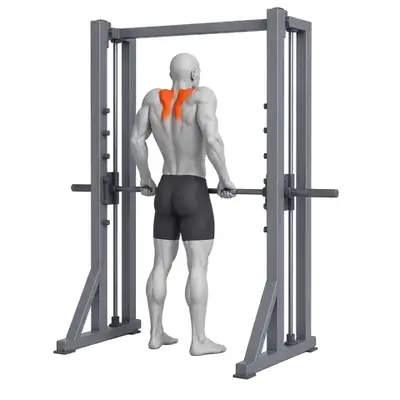
Machine
Steps and tips
A shrug on the Smith machine. The fixed bar path means you can load the traps heavily without balancing anything.
How to do it
- Stand with the bar in front of your thighs and grip it about shoulder width apart.
- Unhook the bar and stand tall with straight arms.
- Shrug your shoulders straight up as high as they will go.
- Pause at the top, then lower slowly.
Keep in mind
- Straight up and down, no rolling.
- Straps let you load the traps past what your grip can hold.
-
Barbell
Steps and tips
Also works upper back and shoulders.
An explosive pull from the hang with a wide snatch grip, driving the bar to chest height. Works the traps, upper back and hips.
How to do it
- Hold the bar with a wide overhand grip and stand tall, then push your hips back to lower it to just above your knees.
- Drive your hips forward hard and shrug as the bar passes your thighs.
- Let the momentum carry the bar up, pulling your elbows high and wide until the bar reaches your chest.
- Lower the bar under control back to the hang and repeat.
Keep in mind
- The hips start it. The arms only finish what the hips began.
- Keep the bar close to your body the whole way up.
-
Barbell
Steps and tips
Also works hamstrings, glutes, lower back and rear delts.
A wide-stance deadlift that flows into an upright pull to the chin. A full-body pull that hits the traps and shoulders hard.
How to do it
- Stand with a wide stance, toes turned out, and grip the bar with your hands close together inside your knees.
- Drive through your legs to stand, keeping your back flat and the bar close.
- As you reach standing, keep the bar moving by pulling your elbows high and wide until the bar reaches your chin.
- Lower the bar under control back to the floor and repeat.
Keep in mind
- It is one smooth movement from the floor to the chin, not a deadlift and then a row.
- Elbows stay above the bar at the top.
-
Barbell
Steps and tips
A shrug standing inside a trap bar. The neutral handles make it comfortable and let you load the traps heavily.
How to do it
- Stand inside the trap bar, hinge down, and grip the handles.
- Stand tall with straight arms and your chest up.
- Shrug your shoulders straight up as high as they will go.
- Pause at the top, then lower slowly.
Keep in mind
- Straight up and down, no rolling.
- Keep your arms straight. Bending them lifts the bar, not your shoulders.
More back exercises 1
-
Barbell
Steps and tips
Also works lats, rear delts and biceps.
A barbell row that starts from a dead stop on the floor or rack pins every rep. No momentum, so the back does all the work.
How to do it
- Set the bar on the floor or on rack pins at about mid shin, and stand over it with your feet about hip width apart.
- Hinge down with a flat back and grip the bar a little wider than your shoulders.
- Row the bar hard to your lower chest, keeping your torso still.
- Lower it all the way back down and let it settle completely before the next rep.
Keep in mind
- Every rep starts from a full stop. If the bar bounces, you have lost the point.
- Drive the elbows back rather than pulling with your hands.
Nothing here matches that equipment.
Also works your back
97 exercises from other groups
These are filed under another muscle, and work your back as well.
- Banded Face PullShoulders
- Banded Romanian DeadliftGlutes & Hips
- Barbell Ab RolloutCore
- Barbell LungeGlutes & Hips
- Barbell Rear Delt RowShoulders
- Barbell Reverse LungeGlutes & Hips
- Battle RopesShoulders
- Behind-the-Neck PressShoulders
- Bent-Over Pronated FlyShoulders
- Bent-Over Reverse FlyShoulders
- Bodyweight Lateral RaiseShoulders
- Bodyweight Overhead PressShoulders
- Cable External RotationShoulders
- Cable Front RaiseShoulders
- Cable Upright RowShoulders
- CleanFull Body & Power
- Clean & JerkFull Body & Power
- Clean PullFull Body & Power
- DeadliftHamstrings
- Devil PressFull Body & Power
- Double Kettlebell CleanGlutes & Hips
- Double Kettlebell Dead Split SnatchShoulders
- Double Kettlebell JerkShoulders
- Double Kettlebell Rear Delt RowShoulders
- Double Kettlebell Split JerkShoulders
- Double Kettlebell Swing SnatchGlutes & Hips
- Dumbbell CleanFull Body & Power
- Dumbbell Clean and PressFull Body & Power
- Dumbbell DeadliftHamstrings
- Dumbbell Face PullShoulders
- Dumbbell Front SquatGlutes & Hips
- Dumbbell Kickstand DeadliftGlutes & Hips
- Dumbbell Push PressShoulders
- Dumbbell SnatchFull Body & Power
- Dumbbell ThrusterFull Body & Power
- Dumbbell Upright RowShoulders
- Face PullShoulders
- GHD Hip ExtensionGlutes & Hips
- GHD Sit-UpCore
- Glute KickbackGlutes & Hips
- Hang CleanFull Body & Power
- Hang Power CleanFull Body & Power
- Hang Power SnatchFull Body & Power
- Hang SnatchFull Body & Power
- Hanging PikeCore
- Kettlebell CleanFull Body & Power
- Kettlebell Clean & PressFull Body & Power
- Kettlebell Kickstand DeadliftGlutes & Hips
- Kettlebell Single Leg DeadliftGlutes & Hips
- Kettlebell SnatchFull Body & Power
- Kettlebell Sumo DeadliftGlutes & Hips
- Kettlebell WindmillCore
- Lateral Raise (90°)Shoulders
- Machine Assisted DipsChest
- Muscle SnatchFull Body & Power
- Overhead CarryShoulders
- Overhead SquatGlutes & Hips
- Pike Push UpsShoulders
- Plate-Loaded Lateral RaiseShoulders
- Power CleanFull Body & Power
- Power SnatchFull Body & Power
- Push JerkFull Body & Power
- Rear Delt Cable FlyShoulders
- Rear Delt FlyShoulders
- Rear Delt Fly (Machine)Shoulders
- Reverse Cable FlyShoulders
- Reverse Plank DipsTriceps
- Reverse Tabletop Hip PulsesGlutes & Hips
- Ring Face PullShoulders
- Sandbag Clean & CarryFull Body & Power
- Seated Barbell Overhead PressShoulders
- Seated Dumbbell Shoulder PressShoulders
- Seated Smith Machine Shoulder PressShoulders
- Side-Lying Lateral RaiseShoulders
- Single Arm Dumbbell SwingGlutes & Hips
- Single Arm Kettlebell Front SquatGlutes & Hips
- Single Arm Kettlebell Push PressShoulders
- Single Arm Kettlebell Shoulder PressShoulders
- Single Arm Kettlebell SwingGlutes & Hips
- Single Arm Machine Shoulder PressShoulders
- Smith Machine Romanian DeadliftHamstrings
- Smith Machine Shoulder PressShoulders
- Smith Machine Upright RowShoulders
- SnatchFull Body & Power
- Snatch BalanceFull Body & Power
- Snatch PullFull Body & Power
- Split JerkFull Body & Power
- Stiff-Leg DeadliftHamstrings
- Suitcase CarryCore
- ThrusterFull Body & Power
- Trap Bar DeadliftHamstrings
- TRX Face PullShoulders
- TRX Hip PressGlutes & Hips
- TRX Oblique CrunchCore
- TRX Y-FlyShoulders
- Upright RowShoulders
- VersaClimberFull Body & Power
Photos: Richard R on Unsplash. Exercise animations by RepDB. Muscle pictures drawn from react-native-body-highlighter (MIT licence).
Coming soon to iOS
Ready to throw the notes app out?
All 99 back exercises on this page are already in SetLift. Log your sets as you go, and next session it shows you what you lifted last time.
Free forever plan. No ads, no trackers.