
Running a Push Pull Legs (PPL) split without a progression system is the fastest way to stay the same size and strength for six months. Most lifters walk in, hit bench on Push day, stop whenever a set feels hard, and log nothing. They treat PPL as a playlist instead of a plan.
PPL groups muscles by what they do: pushing muscles (chest, front delts, triceps), pulling muscles (lats, upper back, rear delts, biceps), and legs (quads, glutes, hamstrings, calves). The split on its own doesn't make you grow; making the work harder over time does.
Here's how to progress your compound lifts, use double progression on accessories, and log each session.
On this page
Why Push Pull Legs Stalls Without a Progression Rule
The main reason lifters stall on PPL isn't exercise selection. It's the illusion of effort. You can leave the gym drenched with a huge pump, but if the weight on the bar and the hard reps you did are the same as twelve weeks ago, your body has no reason to build new muscle.
Muscle growth is driven mainly by mechanical tension, the force your muscles produce working against heavy resistance through a full range of motion. To keep growing, that tension has to climb over weeks and months.
When you run PPL without tracking, fatigue hides a lack of progress. Say you do 4 sets of incline dumbbell presses with 70 lbs (32 kg) one week and 3 sets with 75 lbs (34 kg) the next. Both sessions feel exhausting, but without your reps written down you can't tell whether you actually did more work or less.
Logging takes the guesswork out: last session you benched 205 lbs (93 kg) for 8, 8, and 7 reps. Today's goal is simple: get that 8th rep on the third set. That one extra rep is measurable progress.
Choosing Your Split: 4-Day Rolling vs. 6-Day Classic PPL
PPL is often treated as a 6-day program. In practice, six days a week can be hard to recover from if you work full time, sleep around 7 hours, and deal with normal life stress. Pick the version that fits the recovery you actually have, not the one that sounds most hardcore.
The 4-day rolling PPL (more recovery)
The rolling split cycles through the three workouts with rest days built in, so you train about four days a week. Two 5-day cycles look like this:
Because the cycle is five days long, your workouts shift across the calendar week. The payoff is recovery: each muscle group gets about four full days off before you train it again, and you never stack three hard sessions back to back.
The 6-day classic PPL (higher frequency)
The classic split runs the full cycle twice each week, with one rest day:
You hit every muscle twice a week, but there's little room for error. If your sleep, food, or volume are off, fatigue builds quickly. On the 6-day version you can repeat the workouts below on both days, or swap in a variation on the second day (for example, flat barbell bench instead of incline).
Side-by-side comparison
| 4-Day Rolling | 6-Day Classic | |
|---|---|---|
| Training days | About 4 per week | 6 per week |
| Each muscle trained | Every 5th day | Twice a week |
| Rest days | 2 per 5-day cycle | 1 per week |
| Time off per muscle | About 4 days | 2-3 days |
| Overall fatigue | Low to moderate | High |
| Best for | Intermediates and busy schedules | Experienced lifters with dialed-in sleep and food |
Not sure? Start with the 4-day split and move to six days once you're recovering well and still progressing.
How to Progress on Push Pull Legs
Progressive overload doesn't mean adding 5 lbs (2.5 kg) every single session. That works in your first few months of lifting, then stops working once you're past the beginner stage.
To keep progressing, use a different rule for each type of exercise:
1. Main compound lifts: linear progression
- Target: fixed sets and reps, like 3 × 6 or 3 × 8.
- Execution: use the same weight for every set in the session.
- The rule: if you hit every rep on every set with clean form, add weight next session. If you don't, keep the weight and try again.
- How much: add 5 lbs (2.5 kg) on upper-body lifts and 5-10 lbs (2.5-5 kg) on lower-body lifts. If your gym has fractional plates (1.25 lb or 0.5 kg), use them. Adding 2.5 lbs (1 kg) instead of 5 keeps linear progression working longer.
Not sure where to start? Estimate your max and get working weights with the 1RM & working weight calculator, then check how to load the bar with the barbell plate calculator.
2. Accessories: double progression
Trying to add 5 lbs every week to lateral raises, triceps extensions, or dumbbell presses wrecks your form fast. Going from a 25 lb to a 30 lb dumbbell is a 20% jump.
For accessories, use double progression:
- Pick a rep range, such as 3 sets of 8 to 12.
- Choose a weight you can do for 3 sets of 8 with 1 to 2 reps left in the tank.
- Keep that weight the same each session and try to add reps.
- Once you hit 12 reps on all 3 sets, move up to the next weight (for example, 70 lb to 75 lb dumbbells).
- Your reps will drop back toward 8. Build them back up and repeat.
Worked example: flat dumbbell bench press (3 × 8-12)
Here's what double progression looks like across four sessions:
| # | Weight | Reps | Total | What to do |
|---|---|---|---|---|
| 1 | 70 lbs32 kg | 10/9/8 | 27 | Starting point. Keep the weight. |
| 2 | 70 lbs32 kg | 11/10/9 | 30 | +3 reps. That's progress. |
| 3 | 70 lbs32 kg | 12/12/12 | 36 | Top of the range on every set. Go up. |
| 4 | 75 lbs34 kg | 9/8/8 | 25 | New weight. Build back toward 12. |
In session 4 your total reps dropped from 36 to 25, but the weight in your hands went up about 7%.
Complete Push Pull Legs Workouts
These workouts balance hard work with recovery. Don't pile on extra sets. Do every working set with strict form, stopping 1 to 2 reps short of failure. To see how many hard sets each muscle needs per week, read our guide to weekly sets per muscle.
Push workout (chest, front delts, triceps)
Form note: set the incline bench between 15° and 30° to keep the focus on your upper chest instead of your front delts. Keep your chest up and shoulder blades pulled back throughout.
Pull workout (back, rear delts, biceps)
Form note: chest-supported rows take your lower back out of the movement, so it isn't tired before Leg day. Drive your elbows back toward your hips instead of pulling with your hands.
Leg workout (quads, glutes, hamstrings, calves, core)
Form note: on Romanian deadlifts, push your hips back like you're reaching for the wall behind you. Stop lowering once your hips stop moving back, which keeps the work in your hamstrings and out of your lower back.
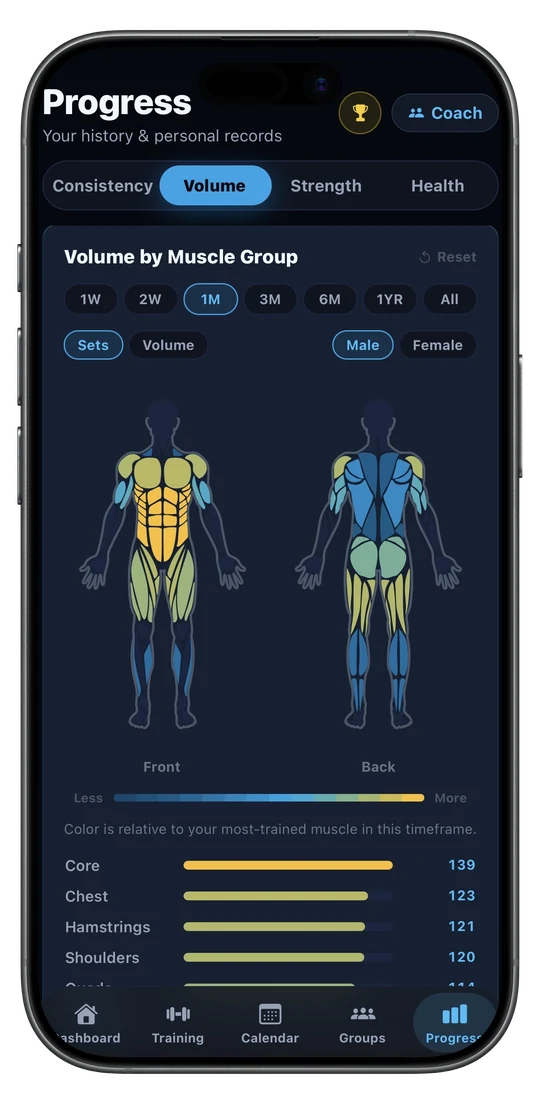
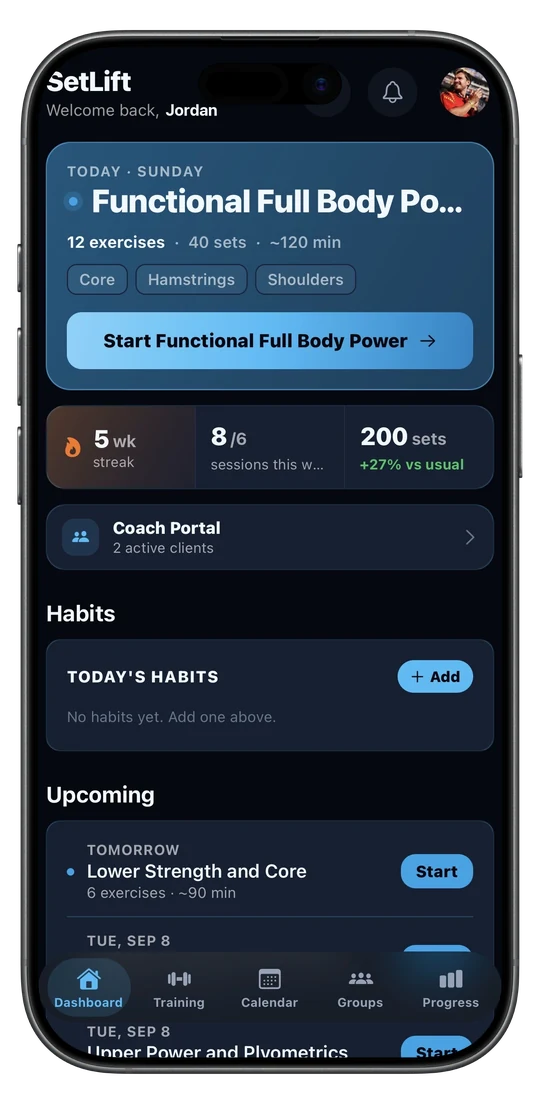
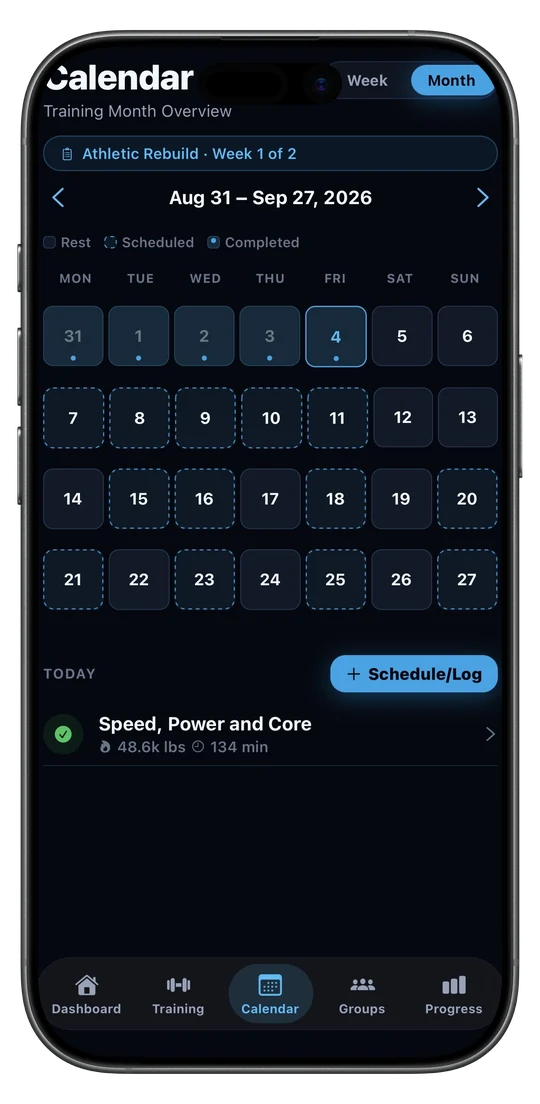
Skip the notebook. Run PPL in SetLift.
SetLift's Explore library includes a ready-made Push Pull Legs routine. Save it, log your sets, and SetLift suggests your next session's weights and reps based on how today went.
Get notified at launchHow to Break Plateaus on Push Pull Legs
Even with good progression rules, specific lifts will stall.
- A session doesn't beat your bestLog it honestly and change nothing.
- It happens againCheck your sleep, food, and stress.
- Three in a rowThe lift has stalled.
- Do a 10% resetDrop the weight about 10%, keep your form strict, and work back up over 4 to 5 sessions.
1. The three-session rule
Never change your program because of one bad workout. Poor sleep, a stressful day, or not eating enough can easily knock a rep or two off a set. Here's how to tell a bad day from a real stall:
- Session 1: 225 lbs (102 kg) for 8, 7, 6. That's 21 reps against a 3 × 8 target, so you keep the weight.
- Session 2: 225 lbs for 8, 7, 7. That's 22 reps, one more than last time. That's progress, so stay the course.
- Sessions 3-5: 22, 21, then 22 reps. Three sessions in a row without beating 22.
On a main lift you only add weight once you hit every rep, but total reps tell you whether you're still moving toward that.
2. The 10% reset
Once a lift stalls, reset it:
- Drop the weight by about 10%. If you were stuck at 225 lbs (102 kg), go to 200 lbs (91 kg).
- Keep the same sets and reps (3 × 8).
- The first session back will feel easy. Don't chase extra reps. Lift each rep fast and lower it under control, over about 3 seconds.
- Add 5 lbs (2.5 kg) each session over the next 4 to 5 workouts until you're back at your old weight.
By the time you're back at 225 lbs, you've had a lighter few weeks to recover, which is usually enough to push past your old numbers.
3. Watch for fatigue that carries across days
On a PPL split, workouts affect each other. Heavy Romanian deadlifts on Leg day also work your upper back, traps, and lower back hard. If your Pull day comes right after Leg day, your rows will suffer.
If your pulling strength is dropping, look at your schedule:
- Keep heavy hinges away from heavy rows. Avoid putting heavy deadlifts within a day of heavy barbell rows.
- Watch your pressing volume. All chest and shoulder presses work your front delts. Stacking heavy overhead presses, incline presses, and front raises in one session can leave your shoulders beat up.
- Spot whole-body fatigue early. If your numbers are dropping on everything at once, not just one lift, a 10% reset on one exercise won't fix it. That's the time for a planned deload week.
Free Tools for This Program
Frequently Asked Questions
Is a 4-day or 6-day PPL split better for progressive overload?
Both work. The 4-day rolling split trains each muscle about every fifth day and leaves more room to recover, which suits most people with busy schedules. The 6-day split hits each muscle twice a week, but with only one rest day it takes good sleep, food, and fatigue management to keep progressing.
What is double progression on Push Pull Legs?
Double progression means keeping the weight the same while you add reps within a target range, such as 3 sets of 8 to 12. Once you hit the top of the range on every set, you move up to the next weight and start again near the bottom of the range.
How much weight should I add when I progress on compound lifts?
For upper-body compounds like the bench press or overhead press, add 5 lbs (2.5 kg) to the bar. For lower-body compounds like squats and Romanian deadlifts, add 5 to 10 lbs (2.5 to 5 kg). If a 5 lb jump drops your reps below target, use fractional plates (1.25 lb or 0.5 kg per side) to add 2.5 lbs (1 kg) instead.
What should I do when I stop adding reps?
Don't change anything after one bad session. If you go three sessions in a row without beating your best total reps on a lift, drop the weight by about 10%, keep the same sets and reps, and add 5 lbs (2.5 kg) per session until you're back at your old weight. That short step back is usually enough to push past your old numbers.
How long should I rest between sets on Push Pull Legs?
Rest 3 to 4 minutes on your main compound lifts, like squats, incline bench, and heavy rows, so you can give full effort on every set. On secondary compounds like dumbbell presses and pulldowns, 2 to 3 minutes. On isolation work like lateral raises, curls, and leg curls, 60 to 120 seconds. Cutting rest too short costs you reps and makes your logged numbers harder to compare.
This guide is for educational purposes only and is not medical advice. Check with a physician before starting an intense resistance training program, and stop any exercise that causes pain.