
When your lifts stall, the instinct is to push harder: more exercises, more sets to failure, more time in the gym. But the weight on the bar often stays stuck anyway.
A better first step is to look at your training volume: how many hard sets each muscle actually gets per week. Too few and a muscle isn't getting enough work to keep growing. Too many and you pile up fatigue you can't recover from. Without counting, you're guessing which one it is.
On this page
Why Training Harder Stops Working
In your first year or so of lifting, almost any hard training makes you bigger and stronger. After that, progress gets harder to come by, and simply working harder doesn't guarantee results.
More sets help, but less each time
A 2026 meta-analysis of the research found that both muscle growth and strength increase as weekly volume goes up, but with diminishing returns. Each extra set adds a bit less than the one before, and the effect flattens out faster for strength than for muscle size (Pelland et al., 2026).
Junk volume
"Junk volume" means sets that add fatigue without adding much benefit. It usually comes from two places:
- Sets that are too easy. Stopping five or six reps short of failure gives your muscles much less reason to grow.
- Sets done when you're already spent. Late in a long session for one muscle, your form and reps drop, and each extra set does less.
Count Hard Sets, Not Tonnage
Why tonnage misleads
A common way to measure volume is tonnage: weight × reps × sets. Compare two chest workouts:
Hard sets: 3
Hard sets: 3
By tonnage, Lifter A did about 50% more work. But research comparing light and heavy training finds they build similar amounts of muscle when sets are taken close to failure, while heavier sets build more strength (Schoenfeld et al., 2017). If both lifters pushed their sets hard, they likely built about the same muscle: three hard sets each.
What counts as a hard set
A set counts toward your weekly volume when it meets all of these:
- Full range of motion with consistent form.
- Controlled reps, not bounced or dropped.
- Close to failure, usually ending within about 0 to 3 reps in reserve (RPE 7 to 10). Our guide to RPE and RIR shows how to judge this.
Warm-up sets and easy sets that stop well short of failure don't count. You also don't need to go all the way to failure for a set to count: a review found training to failure gave little to no extra muscle growth compared with stopping a little short (Refalo et al., 2023).
Count direct and indirect sets differently
Compound lifts train more than one muscle. A bench press works your chest most, but your triceps help too. A useful rule:
- 1 set for the main muscle an exercise trains (chest on bench press).
- 0.5 set for each muscle that assists (triceps on bench press, biceps on rows).
The same 2026 meta-analysis compared ways of counting and found this half-set method predicted results better than counting assisting muscles as full sets or ignoring them (Pelland et al., 2026).
How Many Sets per Muscle per Week?
There's no single magic number, but the research gives useful guideposts:
- More sets, more growth, up to a point. An early meta-analysis found a graded relationship: in the studies it pooled, 10 or more weekly sets per muscle averaged about 9.8% muscle growth, compared with 5.4% for fewer than 5 sets (Schoenfeld et al., 2017).
- 12 to 20 sets for trained lifters. A review of studies on trained young men suggested 12 to 20 weekly sets per muscle as a good target. Going above 20 didn't clearly help, except for the triceps, though only a handful of studies were available (Baz-Valle et al., 2022).
A practical approach: start around 10 hard sets per muscle per week, then adjust based on how that muscle responds and how well you recover.
A note on "volume landmarks"
You may have seen terms like MEV (minimum effective volume), MAV (maximum adaptive volume), and MRV (maximum recoverable volume). They come from a coaching framework popularized by Dr. Mike Israetel. The idea is useful: a floor, a sweet spot, and a ceiling. But the exact numbers differ from person to person and muscle to muscle, so treat any chart of them as a rough starting point, not a measurement.
Worked Example: Counting Sets in Our PPL Program
Here's the weekly set count for each muscle in our Push Pull Legs program, using the direct/indirect rule above. The 4-day rolling split runs each workout about 1.4 times per week; the 6-day split runs each one twice. The table shows the main muscles; glutes, calves and rear delts follow the same rule.
| Muscle | Per cycle | 4-day per week | 6-day per week |
|---|---|---|---|
| Chest | 6 | 8.4 | 12 |
| Back | 9 | 12.6 | 18 |
| Quads | 6 | 8.4 | 12 |
| Hamstrings | 6 | 8.4 | 12 |
| Triceps | 7.5 | 10.5 | 15 |
| Biceps | 7.5 | 10.5 | 15 |
| Side delts | 5.5 | 7.7 | 11 |
Numbers in amber are under the 10-set starting point. How it's counted: triceps get 3 direct sets from overhead extensions plus half credit for 9 sets of pressing (7.5 per cycle). Biceps get 3 direct sets from curls plus half credit for 9 sets of rows and pulldowns. Side delts get 4 sets of lateral raises plus half credit for overhead press.
What this tells you:
- On the 4-day split, chest, quads, hamstrings, and side delts land around 8 sets per week, a bit under the 10-set starting point. If one of those is stalling and you're recovering well, it's a good candidate for a couple more sets.
- On the 6-day split, almost everything is in the 11 to 18 range. If you're stalling here, more sets probably isn't the answer. Look at how hard your sets are, your sleep and food, or whether it's time for a deload.
See where your training goes.
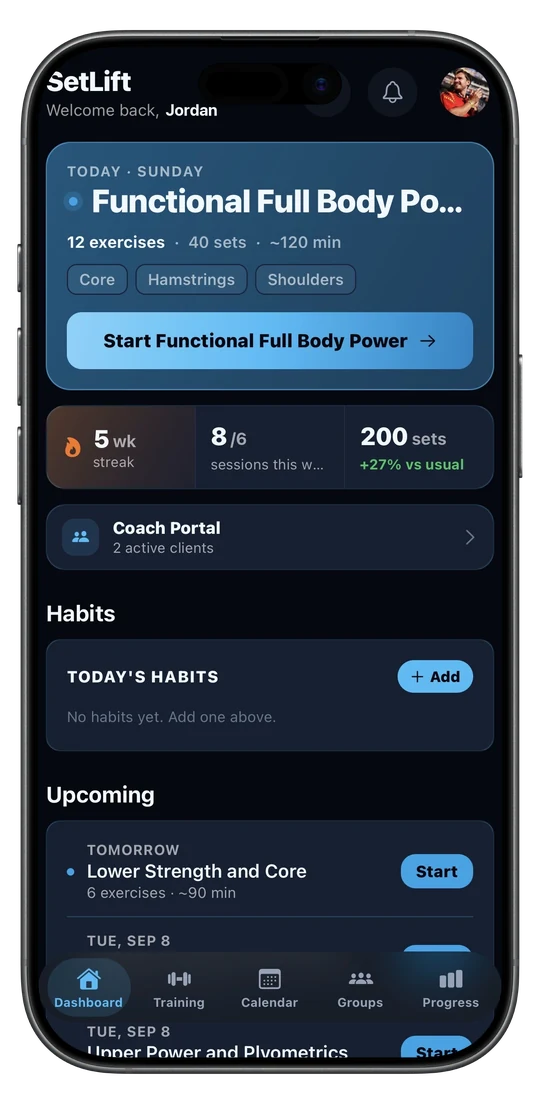
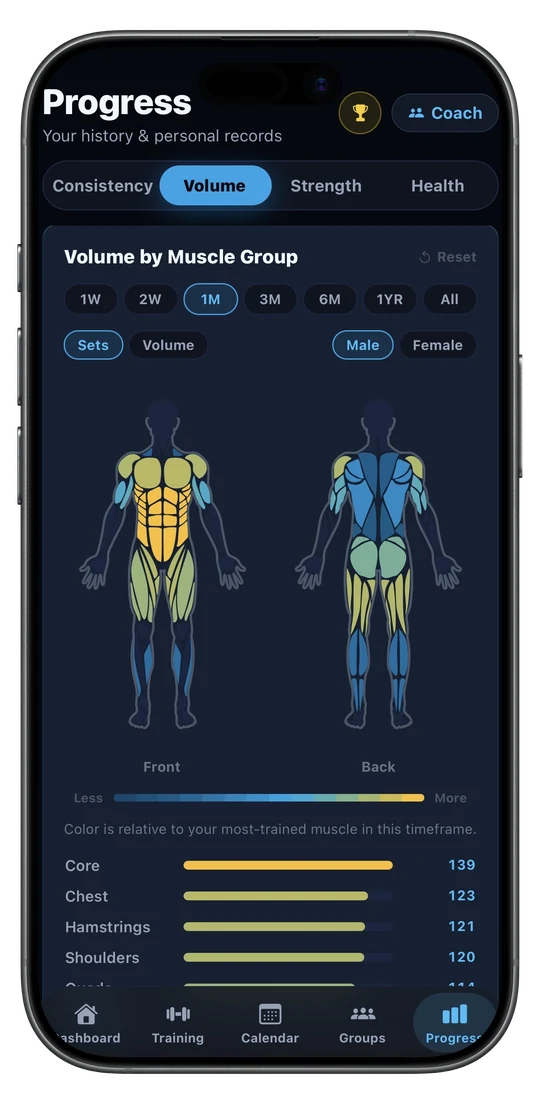
SetLift's progress screen shades a body map by how many hard sets each muscle group has taken, so a muscle that's getting left behind stands out without counting by hand.
Get notified at launchFix a Plateau with Volume in 3 Steps
- Count your current setsTally hard sets per muscle per week, using 1 for direct and 0.5 for indirect sets.
- Add 2 to 3 sets to the stalled muscleOnly that muscle, and only a few sets per week. Don't double everything at once.
- Run it for 3 to 4 weeksWatch your reps and estimated 1RM on that muscle's main lifts.
Step 2 in practice
Say you're on the 4-day split and your chest has stalled at about 8 sets per week. Add one set each to incline bench and flat dumbbell bench on Push day. That's 2 more sets per cycle, which takes chest to about 11 sets per week, without touching anything else.
Step 3: read the results
- Reps and estimated 1RM going up: the extra volume was what that muscle needed. Keep it.
- Still flat and you feel beat up: you may be past what you can recover from. Take a deload week, then go back to the lower volume or try a different exercise.
- Still flat but you feel fine: check how hard your sets are. If they're ending 4 or more reps short of failure, push closer before adding more sets.
Spotting Lagging Muscles
Lifting by feel often means some muscles get plenty of work while others get very little, and that imbalance can stall your big lifts.
When a helper muscle falls behind
A bench press works your chest most, with your triceps and front delts helping. If your chest is growing but your bench slows down near lockout, your triceps may be the weak link. Under the half-set rule, pressing only gives triceps half credit, so direct work like pushdowns or overhead extensions can make up the difference.
Stop guessing whether you did enough.
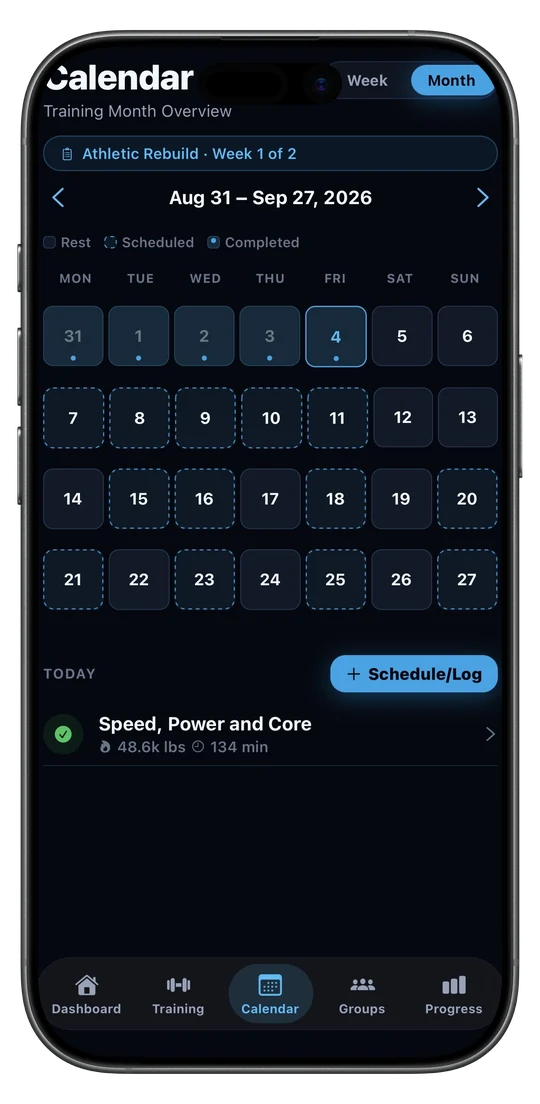
SetLift counts the hard sets for you, tracks your PRs, and suggests your next weight and reps from your last session.
Get notified at launchFree Tools for Lifters
Frequently Asked Questions
What counts as a hard set?
A working set done with full range of motion and good form that ends close to failure, usually within about 0 to 3 reps in reserve (RPE 7 to 10). Warm-up sets and easy sets that stop well short of failure don't count.
How many hard sets per muscle should you do each week?
Research consistently finds more muscle growth with more weekly sets, with diminishing returns. A review of studies on trained lifters suggested 12 to 20 sets per muscle per week. About 10 sets is a sensible starting point; adjust up or down based on how you progress and recover.
Why is total tonnage a misleading way to track volume?
Tonnage (weight × reps × sets) is much higher for light, high-rep sets than for heavy, low-rep ones. But research finds light and heavy sets build similar muscle when both are taken close to failure. So tonnage can make one workout look far bigger than another when they'd build about the same muscle. Counting hard sets avoids that.
Do compound lifts count toward smaller muscles like triceps?
Partly. A useful rule is to count a set as 1 for the main muscle it trains and 0.5 for muscles that assist, like triceps during a bench press. A 2026 meta-analysis found this half-set method predicted results better than counting indirect sets as full sets or ignoring them.
Should I split my weekly sets across multiple sessions?
Usually, yes. Research suggests how often you train a muscle matters little for growth once total weekly sets are the same, but spreading sets across two or more sessions keeps each set fresher and higher quality. Training a lift more often may also help strength.
Sources
- Pelland JC, Remmert JF, Robinson ZP, Hinson SR, Zourdos MC. The Resistance Training Dose-Response: Meta-Regressions Exploring the Effects of Weekly Volume and Frequency on Muscle Hypertrophy and Strength Gains. Sports Medicine. 2026;56(2):481-505. doi:10.1007/s40279-025-02344-w (2024 preprint)
- Schoenfeld BJ, Ogborn D, Krieger JW. Dose-response relationship between weekly resistance training volume and increases in muscle mass: A systematic review and meta-analysis. Journal of Sports Sciences. 2017;35(11):1073-1082. Link
- Baz-Valle E, Balsalobre-Fernández C, Alix-Fages C, Santos-Concejero J. A Systematic Review of the Effects of Different Resistance Training Volumes on Muscle Hypertrophy. Journal of Human Kinetics. 2022;81:199-210. Link
- Schoenfeld BJ, Grgic J, Ogborn D, Krieger JW. Strength and Hypertrophy Adaptations Between Low- vs. High-Load Resistance Training: A Systematic Review and Meta-analysis. Journal of Strength and Conditioning Research. 2017;31(12):3508-3523. Link
- Refalo MC, Helms ER, Trexler ET, Hamilton DL, Fyfe JJ. Influence of Resistance Training Proximity-to-Failure on Skeletal Muscle Hypertrophy: A Systematic Review with Meta-analysis. Sports Medicine. 2023;53(3):649-665. Link
- Schoenfeld BJ, Grgic J, Krieger J. How many times per week should a muscle be trained to maximize muscle hypertrophy? A systematic review and meta-analysis of studies examining the effects of resistance training frequency. Journal of Sports Sciences. 2019;37(11):1286-1295. Link
This guide is for educational purposes only and is not medical advice. Check with a physician before starting an intense resistance training program.