
When a lift stalls, most lifters respond by doing more: extra sets, harder sets, new exercises. But if your numbers have been sliding across the board for a couple of weeks, the problem usually isn't effort. It's fatigue that has built up faster than you've recovered from it.
A deload week is a planned, short drop in training stress. You keep training, but lighter or with fewer sets, so fatigue can clear while your progress stays put. Done right, you come back a week later fresh and ready to add weight again.
On this page
Why Fatigue Hides Your Progress
The fitness-fatigue model
In 1975, sport scientist Eric Banister and colleagues described training as producing two effects at once. One is fitness: you get stronger, and that improvement builds slowly and sticks around. The other is fatigue: you get tired, and that builds quickly but also clears quickly.
Early in a training block, fitness outpaces fatigue and your numbers climb. After enough hard weeks, fatigue catches up and starts hiding the strength you've built. You haven't gotten weaker. You're just too tired to show it. Because fatigue clears faster than fitness fades, a lighter week lets the fatigue drain away while your strength stays.
Joints recover slower than muscles
Muscles have a rich blood supply and usually bounce back from a hard session within a few days. Tendons and ligaments get far less blood flow and adapt more slowly. That's why achy elbows, knees, or shoulders often show up after several weeks of heavy training, even when your muscles feel fine.
5 Signs You Need a Deload
Don't wait for an injury to force a break. Watch for these:
1. Your lifts are stalling or going backward
One bad session is just an off day. A steady slide is different. If you hit 225 lbs (102 kg) for 8 two weeks ago, 7 last week, and a shaky 5 today, fatigue is winning. If only one lift has stalled, try the 10% reset on that lift first. If most of your lifts are dropping at once, it's time to deload.
2. Your joints ache
Muscle soreness after a new exercise or a jump in volume is normal. A dull ache in your elbows, knees, shoulders, or hips that doesn't go away is not. If warm-up sets with an empty bar feel creaky, your joints need a break.
3. Your sleep or resting heart rate is off
When training stress piles up, some lifters sleep worse: trouble falling asleep despite being tired, or waking up during the night. If you track your resting heart rate, a morning reading that sits a few beats higher than your normal for several days is another sign.
4. You've lost your drive
If walking up to the squat rack fills you with dread instead of focus, or your warm-up weights feel heavy, pay attention. Flat, joyless sessions are often a sign of accumulated fatigue, not a lack of discipline.
5. It's been 4 to 8 weeks
You don't have to wait until you feel run down. Many lifters plan a deload every 4 to 8 weeks. In a 2024 survey of competitive strength and physique athletes, the average was every 5 to 6 weeks, with each deload lasting about a week (Rogerson et al., 2024). Plan yours toward the shorter end if you're training very heavy or eating in a calorie deficit.
Volume Deload vs. Intensity Deload
There are two main ways to deload: cut volume (fewer sets) or cut intensity (lighter weight).
| Volume deload | Intensity deload | |
|---|---|---|
| Sets | Cut by a third to a half | Same as usual |
| Weight | Same as usual | 70-80% of usual |
| Effort | Stop 1-2 reps earlier than usual (about RPE 7) | Easy (about RPE 5-6) |
| Best for | General fatigue, stalled lifts | Achy joints, feeling beat up |
Volume deload: same weight, fewer sets
Keep your normal working weights, do about 40% fewer sets, and stop each set a rep or two short of where you normally would. If you normally bench 205 lbs (93 kg) for 4 sets of 6, your deload is 2 sets of 5 at 205.
This works because the heavy weight is what keeps your strength in place. A 2021 research review concluded that intensity, meaning how heavy you lift, is the key to holding onto strength and muscle, while volume and frequency can be cut a lot (Spiering et al., 2021).
Intensity deload: same sets, lighter weight
Keep your usual sets and reps, but drop the weight to 70-80% of normal. If you usually squat 315 lbs (143 kg) for 3 sets of 5, do 3 sets of 5 at about 225 to 250 lbs (102 to 113 kg).
Lighter weights take stress off sore joints while you keep practicing the lifts.
Which should you choose?
You don't have to pick just one. In the 2024 survey, the typical deload cut sets, lightened the weight, and left more reps in reserve, while keeping the same exercises and training days.
To judge how many reps you're leaving in the tank, see our guide to RPE and RIR.
See fatigue coming before it stalls you.
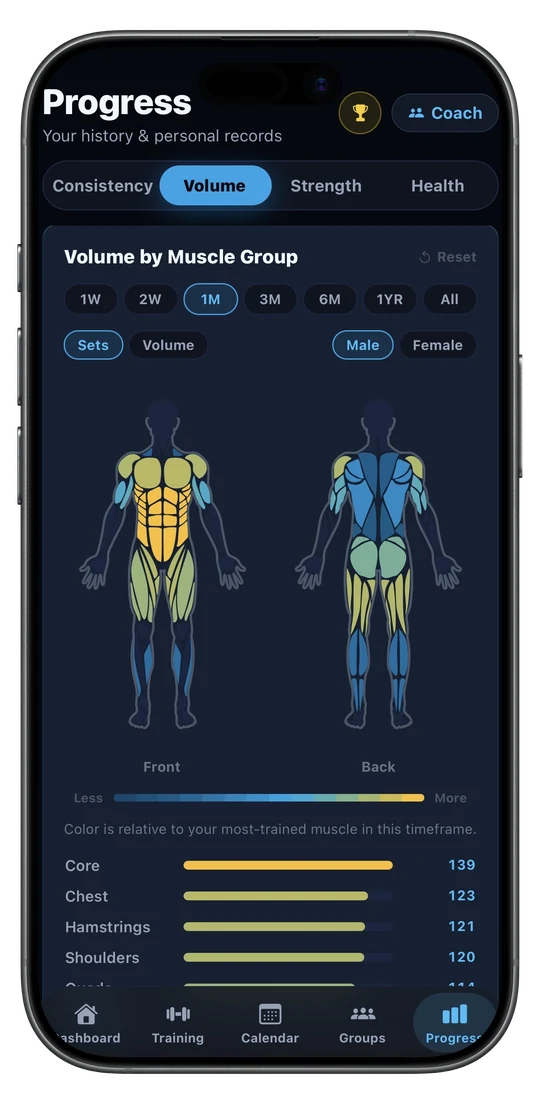
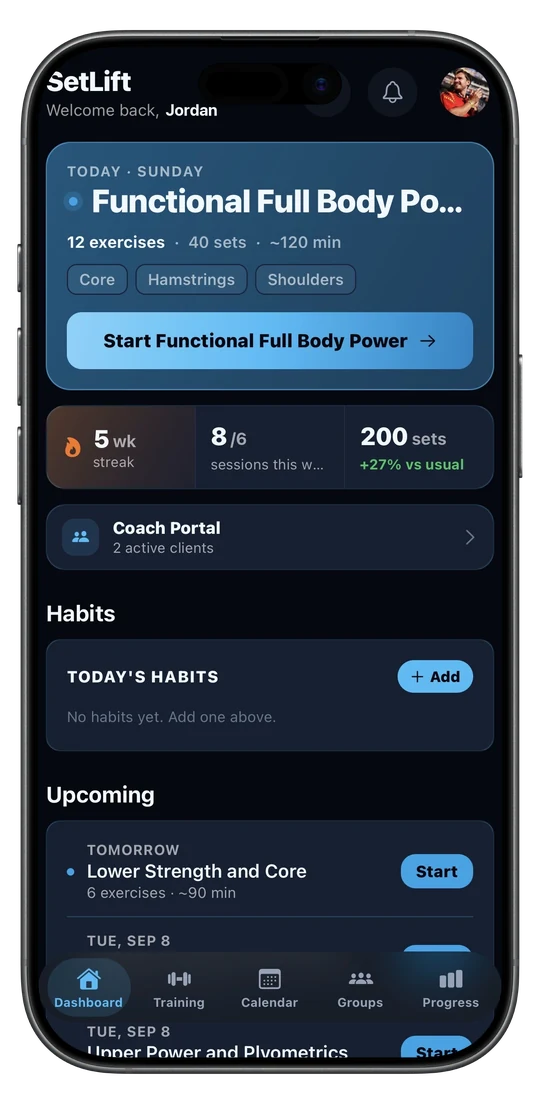
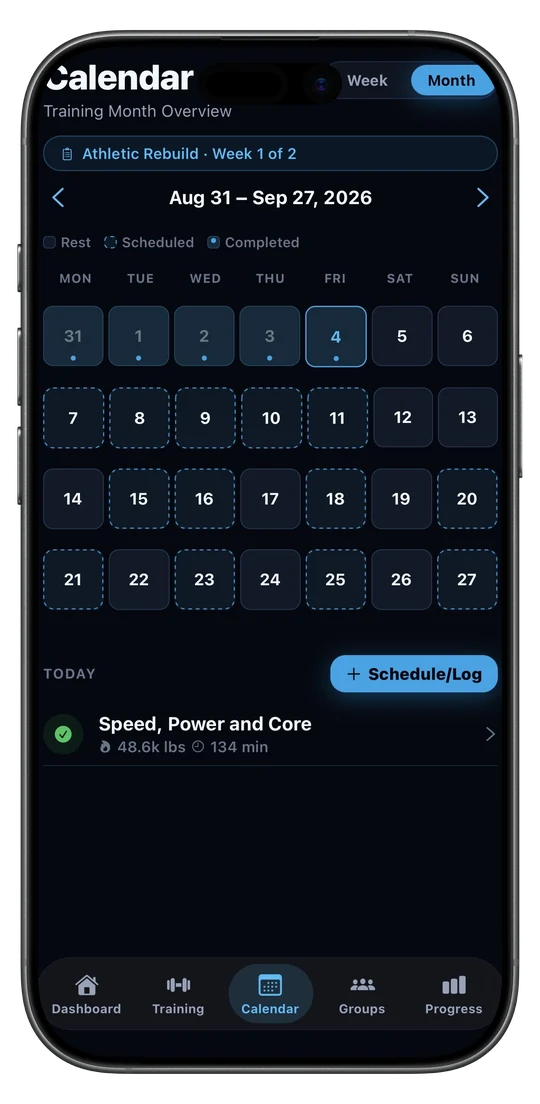
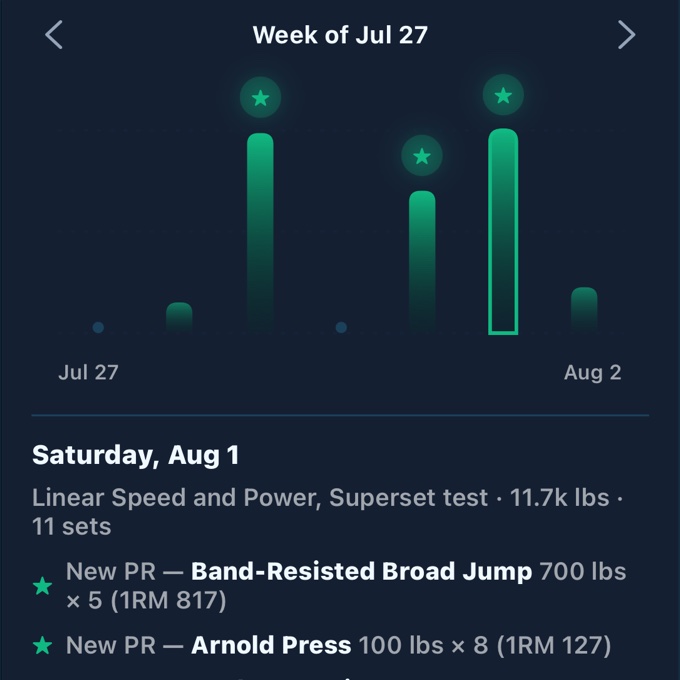
SetLift schedules deload weeks into your training blocks for you, advances your weights off what you actually lifted, and its program recaps show when your numbers start to slide.
Get notified at launchSample Deload Week
Here's what a volume deload looks like for the Push day from our Push Pull Legs program. The exercises and weights stay the same. The sets drop from 16 to 10, and each set stops a rep or two earlier.
| Push day | Normal week | Deload week |
|---|---|---|
| Barbell incline bench | 3 × 6185 lbs (84 kg) | 2 × 5185 lbs (84 kg) |
| Flat dumbbell bench | 3 × 8-1260 lb (27 kg) DBs | 2 × 860 lb (27 kg) DBs |
| Overhead press | 3 × 8-1095 lbs (43 kg) | 2 × 895 lbs (43 kg) |
| Cable lateral raise | 4 × 12-1515 lbs (7 kg) | 2 × 1215 lbs (7 kg) |
| Overhead triceps extension | 3 × 10-1240 lbs (18 kg) | 2 × 1040 lbs (18 kg) |
| Total sets | 16 | 10 |
Pull and Legs days: follow the same rules. Keep your usual weights, drop to 2 sets per exercise, and stop each set a rep or two earlier. You should leave the gym feeling like you could have done much more. That's the point.
What the Research Says About Deloads
Deloads are popular with lifters and coaches, but direct research on them is still limited. What we have so far is useful, though:
- A week off doesn't cost muscle. In a 2024 study, trained lifters who took a full week off halfway through a 9-week program gained about the same amount of leg muscle as those who trained straight through (Coleman et al., 2024).
- But complete rest may cost a little strength. The same study found the group that took the week off gained slightly less squat and knee-extension strength. That's one reason to train lightly during a deload instead of stopping completely.
- Heavy weights are what preserve your gains. Strength and muscle can be maintained on much less training, as long as the weights stay heavy (Spiering et al., 2021).
In short: a deload is a tool for managing fatigue, not a magic boost.
Eating, Sleeping, and Coming Back
Don't cut your food
Don't eat less because you're training less; the week is for recovering.
- Eat at maintenance. A deload isn't the week to start a diet.
- Keep protein where it normally is. A large research review found the benefit of protein for building muscle leveled off around 1.6 g per kg of bodyweight per day (about 0.7 g per pound), with the upper end of the estimate around 2.2 g/kg (1 g per pound) (Morton et al., 2018).
- Prioritize sleep. Use the lighter week to catch up.
The two-week comeback
Your deload sets up the next block. When you come back, don't test your max on day one. A simple way to ramp back up:
- Week 1: use the weights from your last normal week, but do about three-quarters of your usual sets. The weights will probably feel light. Resist adding more.
- Week 2: return to your full sets and start progressing again with your normal rules, like double progression.
Come back and keep climbing.
Log your comeback weeks in SetLift. It tracks your estimated 1RM and suggests your next weight and reps once you're back to full training.
Get notified at launchFree Tools for Lifters
Frequently Asked Questions
Will I lose muscle or strength during a deload week?
One week of lighter training is very unlikely to cost you muscle. A 2021 research review found younger adults kept their strength and muscle size for months on as little as one session a week and one set per exercise, as long as the weights stayed heavy. Older adults needed a bit more to hold onto muscle size.
Should I cut volume or intensity during a deload?
A common default is to keep your working weights and cut your sets by a third to a half, stopping each set a rep or two earlier than usual. If your joints are what's bothering you, lighten the weight instead. Many lifters do a bit of both.
How often should you take a deload week?
Every 4 to 8 weeks is a common starting point. In a 2024 survey of competitive strength and physique athletes, the average was about every 5 to 6 weeks. Take one sooner if your lifts stall across the board, your joints ache, or your motivation drops.
Should I rest completely or train lightly during a deload?
Both can work. In a 2024 study, lifters who took a full week off halfway through a 9-week program gained about the same leg muscle as those who kept training, but slightly less squat strength. Training lightly keeps your technique sharp, so it's usually the better choice unless you need a complete break.
How long should a deload last?
About a week. That's long enough for fatigue to clear without losing fitness, and it's what most lifters do: in the 2024 survey, the average deload lasted about 6 days.
Sources
- Rogerson D, Nolan D, Korakakis PA, Immonen V, Wolf M, Bell L. Deloading Practices in Strength and Physique Sports: A Cross-sectional Survey. Sports Medicine - Open. 2024;10:26. Link
- Coleman M, et al. Gaining more from doing less? The effects of a one-week deload period during supervised resistance training on muscular adaptations. PeerJ. 2024;12:e16777. Link
- Banister EW, Calvert TW, Savage MV, Bach T. A systems model of training for athletic performance. Australian Journal of Sports Medicine. 1975;7(3):57-61.
- Spiering BA, Mujika I, Sharp MA, Foulis SA. Maintaining Physical Performance: The Minimal Dose of Exercise Needed to Preserve Endurance and Strength Over Time. Journal of Strength and Conditioning Research. 2021;35(5):1449-1458. Link
- Morton RW, et al. A systematic review, meta-analysis and meta-regression of the effect of protein supplementation on resistance training-induced gains in muscle mass and strength in healthy adults. British Journal of Sports Medicine. 2018;52(6):376-384. Link
This guide is for educational purposes only and is not medical advice. Check with a physician before starting an intense resistance training program, and see a professional for joint pain that doesn't go away.