
Percentage-based programs look clean on paper: 4 sets of 5 at 80% of your max. But you don't walk into the gym the same person every day. After a bad night's sleep, a stressful week, or a few days of eating less, that 80% can feel like a near-max grind.
Forcing the planned weight anyway leads to sloppy reps, missed sets, and beat-up joints. Autoregulation fixes this by adjusting the weight to how you're actually performing that day, and the two tools lifters use for it are RPE (rate of perceived exertion) and RIR (reps in reserve).
Both describe how close a set was to failure.
On this page
The Problem with Fixed Percentages
Most strength programs prescribe weights as a percentage of a tested max. If your best bench is 225 lbs (102 kg), 80% puts 180 lbs (82 kg) on the bar, no matter how you feel that day.
That assumes your strength stays the same between tests. In reality it moves around from day to day, sometimes by a lot.
What changes from day to day
- Sleep: a short or rough night can make normal weights feel heavy.
- Food: training in a calorie deficit, or on an empty stomach, usually costs you reps.
- Stress: a hard week at work or at home shows up in the gym.
- Leftover fatigue: soreness from an earlier session, like heavy Romanian deadlifts the day before a Pull day, drags down the next workout.
Why 80% can feel like 90%
Say your squat max is 300 lbs (136 kg), so 80% is 240 lbs (109 kg). On a good day, you can squat 240 for 5 clean reps with about 2 left in the tank.
Now say you're about 10% below your best today, so what you could actually lift for a single is closer to 270 lbs (122 kg). The same 240 lbs is now about 89% of what you have. A set meant to be moderate turns into a near-max grind.
RPE vs. RIR
Where lifting RPE came from
RPE started in endurance training with Swedish psychologist Gunnar Borg, whose 6-to-20 effort scale was built to roughly track heart rate. Powerlifter and coach Mike Tuchscherer adapted the idea for lifting in his 2008 book The Reactive Training Manual, using a 1-to-10 scale tied to how many reps you have left before failure.
In 2016, researchers led by Michael Zourdos published an RPE scale based directly on reps in reserve and found that lifters' ratings closely tracked how fast the bar moved: the higher the RPE, the slower the rep (Zourdos et al., 2016).
RIR: the simpler question
"What number out of ten was that?" can be hard to answer mid-workout. RIR asks something more direct: how many more reps could you have done with good form?
Two more clean reps in the tank was 2 RIR; none left is 0 RIR.
How the two scales line up
The conversion is simple: RPE = 10 − RIR.
Interactive RPE Chart: Reps and RPE to % of 1RM
Combine the reps you did with how hard the set felt, and you can estimate what percentage of your max it was. Find the reps you did on the left and your RPE across the top. Enter your 1RM to see working weights instead of percentages.
Showing % of 1RM. Tap any cell to highlight it.
| Reps | RPE 10 | 9.5 | 9 | 8.5 | 8 | 7.5 | 7 |
|---|
Based on the RPE chart from Mike Tuchscherer's Reactive Training Systems (chart values). Weights round to the nearest 5 lbs or 2.5 kg. It's an average starting point: your own numbers may differ, especially at higher reps.
How to use it: a worked example
Say your program calls for a top set of 5 reps at RPE 8, and your estimated bench max is 225 lbs (102 kg).
- Find the 5-rep row and the RPE 8 column: 81.1%.
- Multiply: 225 × 0.811 ≈ 182.5 lbs.
- Round to what you can load: 180 lbs (82 kg), or 182.5 lbs if you have fractional plates. The plate calculator shows how to load it.
- After the set, rate it honestly:
- Felt like RPE 8 (2 reps left): right on target.
- Felt like RPE 9 (1 rep left): you're a bit off today. Keep 180 lbs or drop 5 lbs (2.5 kg) for your back-off sets.
- Felt like RPE 7 (3 reps left): you're stronger than planned. Add 5 lbs (2.5 kg) for the next set.
Work backward to estimate today's max
The chart also works in reverse. If you bench 185 lbs for 5 reps at RPE 8, divide by the chart value: 185 ÷ 0.811 ≈ 228 lbs. That's a reasonable estimate of today's max without testing a true single. For a quick estimate from any set, the 1RM calculator does the same job with the Epley and Brzycki formulas (enter the reps you could have done, 7 here, not the 5 you did).
How to Rate Your Sets Accurately
RPE and RIR only work if your rating matches reality, and most people aren't great at it at first.
Most lifters underestimate how many reps they have left
A 2021 review of the research found that, on average, people underpredicted their reps to failure by about one rep. Accuracy was worse on sets of more than 12 reps, slightly better when the prediction was made closer to failure, and training experience didn't make a clear difference (Halperin et al., 2021).
One rep may not sound like much, but if you think you're at 2 RIR and you're really at 3, your "hard" sets are easier than you planned, and on long sets the miss is bigger. A few habits help:
- Rate the set right away, before you sit down and the effort fades from memory.
- Calibrate on safe exercises. Now and then, take a machine or cable exercise (leg press, machine chest press, cable row) all the way to failure so you know what 0 RIR really feels like.
- Be extra honest on high-rep sets. That's where predictions miss the most.
- Lean on heavier sets. Ratings are usually more reliable on sets of 3 to 8 reps.
Use bar speed as a check
Burning muscles and heavy breathing can make a set feel harder than it was. Bar speed gives you a second opinion. As a rough guide:
- RPE 7: the bar moves quickly the whole way up.
- RPE 8: a small slowdown at the hardest point, but no pause.
- RPE 9: a clear slowdown at the sticking point that takes real effort to push through.
- RPE 10: the bar nearly stops and you grind it to lockout.
Film your heavy sets from the side now and then. If a set felt like RPE 9.5 but the video shows the bar moving fast, you probably had more left than you thought.
RPE Picks the Weight. Your Log Proves Progress.
RPE and RIR help you choose the right weight in the moment. But to know whether you're getting stronger, you need hard numbers written down. Your log should record:
- The exact exercise and equipment
- The weight on the bar or machine
- The number of clean, full-range reps
If you logged 200 lbs (90 kg) for 8 three weeks ago and 205 lbs (93 kg) for 8 today with the same form, you got stronger, whatever the set felt like.
Watch your estimated 1RM trend
Every working set gives you an estimated 1RM from its weight and reps. If it trends up across a training block, your program is working. If it drops sharply for a week or more, fatigue is probably building, and it may be time for a planned deload.
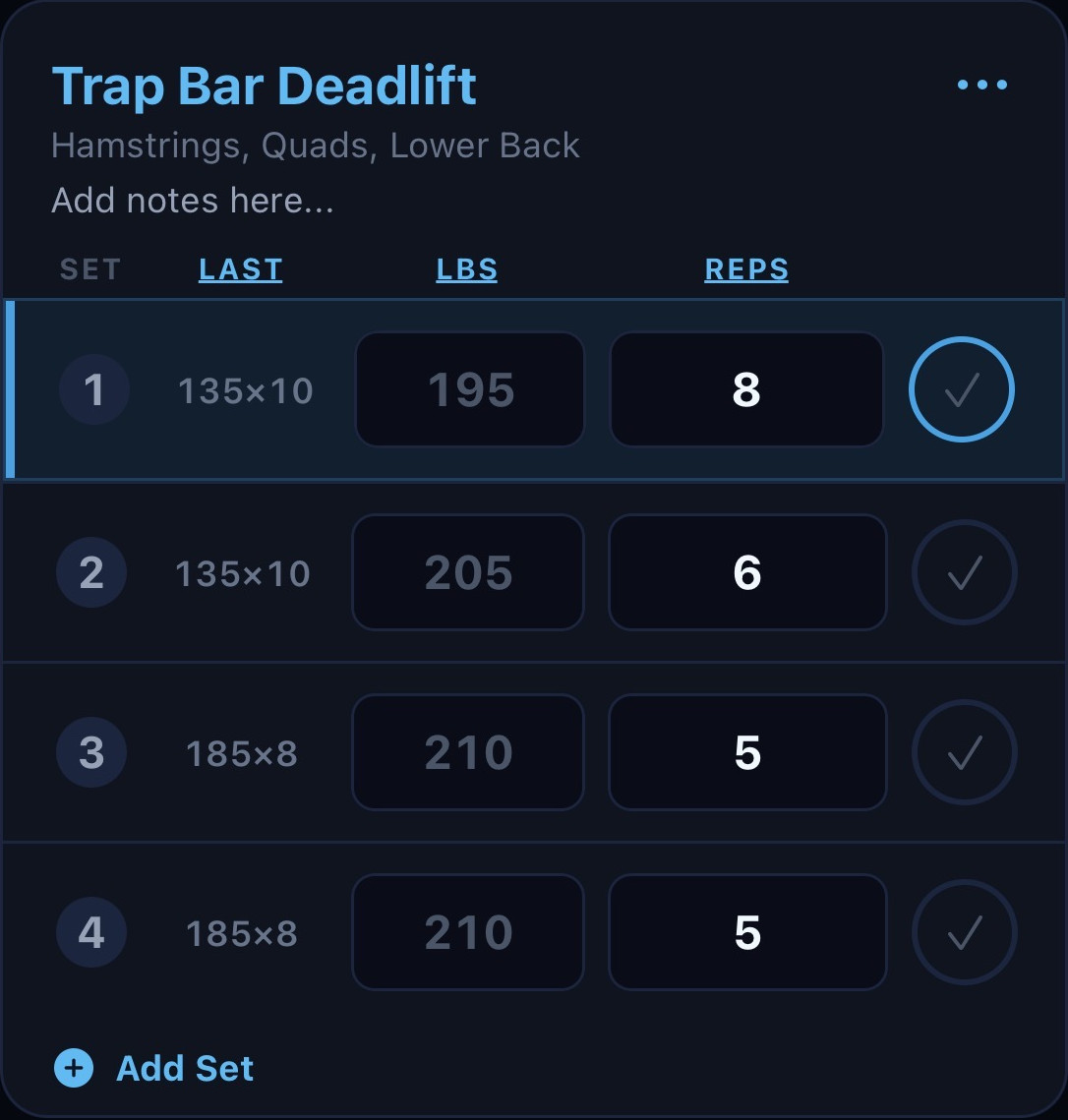
Let SetLift keep the numbers.
SetLift supports both percentage-of-1RM and RPE prescriptions, logs your weights and reps, tracks your estimated 1RM, and suggests your next weight and reps based on your last session.
Get notified at launchFree Tools for Lifters
Frequently Asked Questions
What is the difference between RPE and RIR?
They measure the same thing from opposite directions. RIR (reps in reserve) is how many more reps you could have done with good form. RPE (rate of perceived exertion) puts that on a 1 to 10 scale, where RPE 10 means no reps left, RPE 9 means 1 left, and RPE 8 means 2 left. So RPE = 10 − RIR.
Why is it hard to rate RPE accurately?
Most people underestimate how many reps they have left. A review of the research found lifters underpredicted their reps to failure by about one rep on average, with bigger misses on sets of more than 12 reps. Rating gets easier with heavier sets, when you're closer to failure, and when you occasionally take a safe exercise all the way to failure so you know what it feels like.
Can you use RPE on isolation exercises like biceps curls?
Yes, but it's harder to judge on high-rep isolation sets, where the burn makes it tough to tell how many reps are left. Many lifters keep detailed RPE targets for their main compound lifts and simply take isolation work close to failure, around 0 to 2 reps in reserve.
How does RPE connect to a percentage of 1RM?
An RPE chart estimates what percentage of your max a set represents based on the reps and RPE. For example, 5 reps at RPE 8 is about 81% of your 1RM. You can use that to pick a working weight, or work backward from a set to estimate today's max without testing a true single.
What RPE should most working sets be?
A common approach is to keep most working sets between RPE 7 and 9, or 1 to 3 reps in reserve. Heavy compound lifts often sit around RPE 7 to 8 so form holds up across every set, while isolation work can go closer to failure.
Sources
- Zourdos MC, et al. Novel Resistance Training-Specific Rating of Perceived Exertion Scale Measuring Repetitions in Reserve. Journal of Strength and Conditioning Research. 2016;30(1):267-275. doi:10.1519/JSC.0000000000001049
- Halperin I, et al. Accuracy in Predicting Repetitions to Task Failure in Resistance Exercise: A Scoping Review and Exploratory Meta-analysis. Sports Medicine. 2022;52:377-390 (published online 2021). Link
- Tuchscherer M. The Reactive Training Manual. Reactive Training Systems, 2008. RPE chart values as reproduced by Fitness Volt.
This guide is for educational purposes only and is not medical advice. Check with a physician before starting an intense resistance training program, and stop any exercise that causes pain.